

Published on Oct 09, 2026

Prasanta R
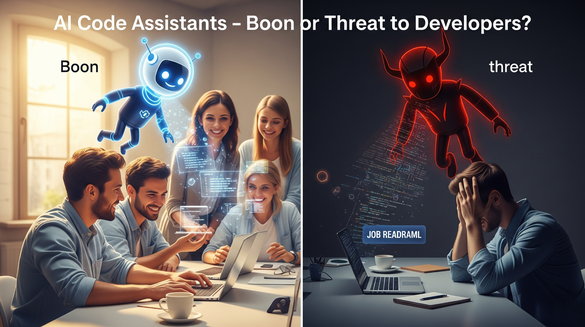
AI Code Assistants – Boon or Threat to Developers?
Google disrupted search in 1998. Engineers called it a fad. Two decades later, businesses can't function without it. We're seeing a phenomenon like déjà vu with AI coding tools. The debate has shifted from "Will they last?" to "How do we leverage them without shooting ourselves in the foot?"
Let us dive in together to actually figure out what AI code assistants actually are: a boon or a threat!
Market Realities vs Marketing Hype

CTOs across Silicon Valley are grappling with a paradox. Their teams report massive productivity gains from AI coding tools, yet project timelines haven't improved proportionally. Something's not adding up.
GitHub's internal data shows 55% productivity improvements with Copilot adoption. Meanwhile, a Stanford study found that experienced developers took 19% longer to complete tasks with AI assistance. Both can't be right—or can they?
The disconnect lies in measurement methodology. GitHub measures lines of code generated. Stanford measured task completion time: different metrics, different stories.
1. Implementation Patterns Across Enterprise Teams
Fortune 500 companies reveal three distinct adoption patterns. Early adopters integrated AI tools without guardrails. Results were mixed: faster initial development, higher technical debt accumulation.
Conservative enterprises waited, watching competitors make mistakes. They're now implementing AI tools with strict governance frameworks. Initial productivity gains are smaller but sustainable.
Mid-market companies split the difference. There are difference between AI writing and human writers that’s why they are selective about AI usage—leveraging it for specific use cases while maintaining human oversight for critical systems.
2. ROI Analysis: Where the Numbers Actually Work
AI coding tools deliver measurable ROI in three scenarios: boilerplate reduction, documentation generation, and junior developer training.
Boilerplate elimination saves senior developers 2-3 hours weekly. At $150/hour loaded cost, that's $450 weekly savings per developer. For a 50-person engineering team, annual savings exceed $1.1 million.
Documentation generation previously consumed 15-20% of developer time. AI tools handle this at 80% accuracy, requiring minimal human editing—nettime savings: 12-15% per developer.
Junior developer onboarding accelerates dramatically. Instead of six months to productivity, well-structured AI-assisted training programs achieve competency in 3-4 months.
3. Parallels from AI Ads
Just as marketers use AI ads to save time on targeting, testing, and creatives, developers use AI coding tools to reduce boilerplate and documentation work. In both cases, automation boosts efficiency but requires oversight to ensure quality and effectiveness. Platforms like Heyoz reflect this shift on the marketing side, helping teams automate ad creatives and experimentation. In both cases, automation boosts efficiency and overall effectiveness.
4. The Hidden Costs Nobody Discusses
Security vulnerabilities in AI-generated code create downstream costs that dwarf initial productivity gains. A single data breach averages $4.45 million in remediation costs. AI tools occasionally introduce subtle security flaws that pass standard code reviews.
Web development companies face particular exposure. Client applications handle payment processing, user authentication, and sensitive data. One compromised API endpoint can trigger massive liability.
Code quality degradation represents another hidden cost. AI-generated code often lacks elegance and maintainability. Short-term productivity gains become long-term technical debt. Refactoring costs compound over time.
Strategic Implementation Framework
Smart organizations aren't asking whether to adopt AI coding tools. They're asking how to implement them strategically. The companies that succeed have developed systematic approaches.
1. Risk-Adjusted Usage Policies
Leading engineering teams categorize code by risk profile. Low-risk utility functions? AI-generated with minimal review. Authentication systems? Human-written content with AI assistance only for non-critical components.
This tiered approach balances productivity gains with quality control. Teams report 30-40% productivity improvements without compromising system integrity.
2. Quality Gates and Review Processes
Effective AI implementation requires modified code review processes. Traditional peer reviews assume human-generated code, but AI-generated code, especially when supported by AI based data extraction software for analyzing code patterns and dependencies, needs different evaluation criteria.
Reviewers check for security vulnerabilities common in AI-generated code, duplicate logic patterns, architectural consistency, and maintainability concerns.
Teams using these enhanced review processes maintain code quality while capturing AI productivity benefits.
3. Developer Skill Development Programs
The most successful implementations include formal training programs. Developers learn prompt engineering, AI output evaluation, and when to override AI suggestions.
These programs cost $5,000-10,000 per developer but generate ROI within six months. Trained developers leverage AI tools 40% more effectively than untrained colleagues.
Competitive Advantage Through Strategic AI Adoption
Companies treating AI coding tools as productivity multipliers rather than developer replacements are building sustainable competitive advantages. They're shipping features faster while maintaining code quality and security standards.
1. Talent Acquisition and Retention Benefits
Skilled developers want to work with innovative tools. Companies offering AI-assisted development environments attract top talent more easily. Employee satisfaction surveys show developers appreciate reduced grunt work and increased focus on creative problem-solving.
However, implementation matters. Developers hate AI tools forced upon them without proper training or clear usage guidelines. Bottom-up adoption with management support works better than top-down mandates. And while the big question, Will AI Replace Web Developers? often comes up, the reality is that AI is more of a helpful teammate than a replacement freeing developers to focus on creativity and strategy instead of repetitive tasks.
2. Client and Market Positioning
A web development company using AI tools can offer more competitive pricing while maintaining margins. Faster development cycles enable more aggressive project timelines. However, client communication requires careful handling.
Some clients worry about AI-generated code quality. Transparent communication about AI usage, coupled with robust testing and quality assurance processes, addresses these concerns effectively.
3. Scalability and Growth Implications
AI-assisted development enables smaller teams to handle larger projects. A 10-person engineering team can manage workloads previously requiring 15-20 developers. This scalability advantage becomes crucial during rapid growth phases.
However, scaling requires careful process management. AI tools can accelerate bad practices as easily as good ones. Companies must establish solid development practices before leveraging AI for scale.
Future-Proofing Development Organizations
The AI code assistant landscape continues evolving rapidly. Organizations must balance current implementation with future adaptability. Five strategic considerations guide successful long-term planning.
1. Technology Investment Strategy
AI coding tools represent infrastructure investments, not one-time purchases. Subscription costs, training expenses, and process modification costs accumulate over time. Budget planning should account for these ongoing expenses.
Tool evaluation criteria should include: integration with existing development environments, security and compliance features, vendor stability and roadmap, and customization capabilities.
2. Skill Portfolio Development
Development teams need hybrid skill sets combining traditional programming expertise with AI collaboration capabilities. This involves enhancing technical skills rather than replacing them.
Architectural thinking that directs the use of AI tools, security awareness for the assessment of AI-generated code, fast engineering for efficient AI communication, and critical evaluation of AI outputs are examples of essential competencies.
3. Organizational Change Management
Adoption of AI tools affects client interactions, project management procedures, and team dynamics. Change management elements that address these organizational implications are a key part of successful implementations, and platforms like Serp-Scale help teams discover and evaluate AI tools across industries to support smoother adoption and better alignment with business needs.
Communication strategies should address developers' worries about job security, clarify expectations for output quality and productivity, and explain AI usage to stakeholders. Exploring tools like a windsurf alternative can also support smoother organizational change by offering flexible pricing, improved collaboration options, or better compatibility with existing workflows.
4. Vendor Risk Management
Relying heavily on AI coding tools creates vendor dependencies. Data privacy and intellectual property security, pricing stability and budget predictability, tool availability and uptime needs, and alternative tool options for business continuity are all things that businesses need to consider.
Successful businesses maximize tool capabilities while minimizing single-vendor risk by maintaining knowledge across several AI platforms.
The software development sector is at a turning point in its history. When used carefully, AI coding tools provide enterprises with real productivity gains. Ongoing investment in developer capabilities, process adjustment, and strategic planning is necessary for success.
Businesses are creating long-lasting competitive advantages by viewing AI products as productivity enhancers rather than cost-cutting instruments. They are providing software more quickly without sacrificing employee satisfaction or quality standards.
The question isn't whether to adopt AI coding tools—market forces make adoption inevitable. The question is how to implement them strategically, maximizing benefits while minimizing risks. Organizations getting this balance right will dominate their markets over the next decade.
Conclusion
The rise of AI code assistants presents a complex dichotomy, offering both a significant boon and a potential threat to the software development landscape. While these tools undeniably enhance productivity by automating repetitive tasks, accelerating debugging, and acting as an invaluable resource for learning new languages and frameworks, their integration is not without peril. Over-reliance on AI could fundamentally alter the developer's role, leading to a deskilling effect where foundational knowledge is overshadowed by prompt engineering. The actual value, however, lies in a new, symbiotic partnership.
The future of development is not one where AI replaces human expertise, but rather where it augments it, freeing developers to focus on higher-level architectural design, creative problem-solving, and genuinely innovative work. Ultimately, the impact of AI code assistants will be determined not by the technology itself, but by how skillfully we, as developers, learn to master and integrate it into our craft.

Safeguard Your Child Against Online Threat
Register Now Cancel Any Time
Available
on
Cancel Any Time
Available
on