
Published on Jul 22, 2026

Super Admin
How Email Sending Frequency Affects Deliverability and Engagement
Introduction
Your copy is beautiful! But does it matter if your carefully crafted masterpieces are languishing in the spam folder? Sending out email too frequently can turn off your audience and lead to spam complaints.
Modern mailbox providers are like ruthless bouncers: they will scrutinize your e-mail activity to determine whether you get the VIP section (your inbox) or the junk folder. In this article, you will learn about the science that stands behind email volume and frequency and what they can say about your mailing practices.
Why Email Sending Frequency Matters?
A. Frequency Shapes Subscriber Expectations
When a Toronto bride registers at a local Toronto bride service, photoboothto.ca, for wedding planning advice, they expect emails from that brand. Regular broadcasting creates a Pavlovian reaction; by changing this pattern, the psychological expectations are removed.
B. Mailbox Providers Monitor Sending Patterns
Gmail and Outlook do not care about your artistic vision. They care about behavioral predictability. ISP spam filters employ complex machine learning algorithms that construct baseline profiles for your sending domain.
A steady flow of emails shows a legitimate business, whereas sudden large volumes force automated filters to throttle your mail.
C. Frequency Influences Overall Campaign Success
Calibrate it, and you get pristine inbox placement and compounding click-through velocities. Get it wrong, and your domain reputation plummets, along with your product launches.
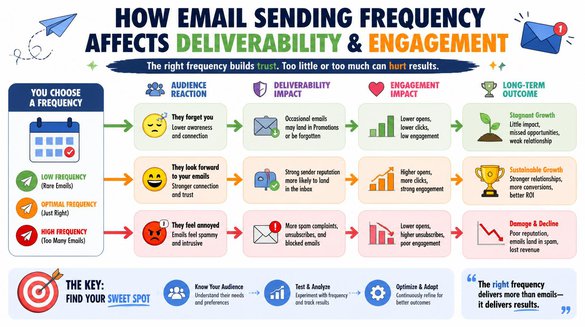
How Sending Too Frequently Can Hurt Deliverability?
A. Subscriber Fatigue
Digital exhaustion is very real. Your audience might love your brand, but blitzing an inbox multiple times a day causes subscribers to leave.
B. Higher Unsubscribe Rates
The moment your brand feels like noise rather than a signal, users look for the exit. A bombardment turns loyal fans into historical data, spiking your opt-out metrics.
C. Increased Spam Complaints
Nothing is worse than a spam button. Laziness drives users; if your opt-out link is hidden, they will click spam to clear their screen.
D. Negative Impact on Sender Reputation
When your complaint rate creeps north of 0.1%, filters begin routing your entire stream away from the primary inbox, causing a drop in open rates.
The Risks of Sending Too Infrequently
A. Subscribers Forget Your Brand
If you only blast your list once every quarter, your subscribers will stare at your name with total blankness; they will assume they were added without consent.
B. Declining Open and Click Rates
When familiarity erodes, your open rates tank, signaling to ISPs that your content is irrelevant to the recipient.
C. Reputation Can Decline Over Time
Long periods of silence cause ISPs to reset your trust metrics, meaning your next massive, unannounced campaign will face intense scrutiny from spam filters.
D. Rebuilding Engagement Becomes More Difficult
You have to slowly coax cold accounts back to life, fighting against algorithmic skepticism.
The Relationship Between Sending Frequency and Sender Reputation
A. What Does Sender Reputation Measure?
Sender reputation is your digital passport score. It is the algorithmic trust rating assigned to your domain and IP address by receiving networks.
B. Positive Signals That Strengthen Reputation
- Sustained, crisp open rates that prove human interest.
- High click-through metrics indicating engaging content.
- Direct replies, which tell ISPs you are having a conversation.
- Consistent, predictable daily volume devoid of erratic spikes.
C. Negative Signals That Weaken Reputation
- High spam complaint percentages exceeding industry thresholds.
- Hard bounces caused by sending to non-existent addresses.
- Widespread deleted-without-reading behaviors from unengaged recipients.
D. Why Reputation Directly Influences Inbox Placement?
ISPs have an infinite desire to protect their users. If your reputation score is immaculate, your mail skips the line straight to the primary tab; if not, you are relegated to the junk folder.
Finding the Right Email Sending Cadence
A. Know Your Audience
A B2B enterprise client wants a high-value weekly digest. However, a consumer looking for party trends might tolerate bi-weekly inspiration. Tailor your pacing to your specific buyer.
B. Segment Subscribers
Stop emailing your entire database. Carve your audience into hyper-focused buckets based on behavioral history.
C. Test Different Sending Frequencies
Run A/B split tests on your cadence. Send Group A your standard weekly update, and Group B a bi-weekly version. Measure the net yield of revenue to find the sweet spot.
D. Adjust Based on Data
Throw out your assumptions. If your metrics show that weekly email drops your total click-to-open ratio by 15%, listen to the data and scale back immediately.
Why New Sending Domains Should Scale Gradually?
A. New Domains Lack Established Trust
A freshly registered domain has zero historical footprint. ISPs view you with default suspicion, unsure if you are a legitimate brand or a malicious spammer spun up an hour ago.
B. Sudden High-Volume Sending Creates Risk
Fire off 10,000 emails on day one from a cold domain, and you will lock your IP faster than you can blink. Massive initial volume flags you instantly across major blacklists.
C. Benefits of Gradual Volume Increases
Stepping up your volume slowly shows filters that you are a responsible sender. It allows positive engagement data to trickle in, gradually cementing your domain legitimacy.
D. Practical Approach
To safely establish a baseline footprint, smart teams execute an intentional email warmup strategy to season their infrastructure and secure high inbox placement.
Measuring Whether Your Sending Frequency Is Working
| Metric | Ideal Trend | Warning Sign |
|---|---|---|
| Open Rates | Stable or increasing | Sudden drop-off over consecutive sends |
| Click-Through Rates | Steady proportional engagement | Sharp declines indicating subscriber boredom |
| Reply Rates | Consistent baseline interactions | Zero interaction, showing a dead list |
| Spam Complaint Rates | Strictly below 0.1% | Spikes immediately following a specific send |
| Unsubscribe Trends | Flatline baseline | Upward trajectory after increasing volume |
When Deliverability Problems Need Expert Guidance?
A. Warning Signs
When your opens fall off a cliff, your un-opens skyrocket, and your beautifully styled updates end up in the spam folder across all major ISPs, your infrastructure is compromised.
B. Common Underlying Causes
The root cause is rarely single-faceted. It is typically broken SPF/DKIM authentication protocols, legacy list rot, and an erratic sending cadence that broke ISP trust.
C. Benefits of Professional Evaluation
An expert diagnostic look bypasses guesswork. It uncovers technical configuration bugs and bad list-hygiene habits.
D. Practical Resource
Bringing in specialized email deliverability consulting can pinpoint the technical bottlenecks, detoxify your sender reputation, and build a roadmap for long-term inbox dominance.
Best Practices for Maintaining Healthy Sending Frequency
- Lock down a strict editorial calendar to maintain operational consistency.
- Never hit send just to clear a task; if the quality is lacking, skip the deployment.
- Tailor content directly to subscriber metadata and behavioral history.
- Audit your deliverability metrics weekly to catch anomalies early.
- Prune unengaged contacts ruthlessly every 60 to 90 days.
Common Mistakes to Avoid
Don't blast your audience daily unless you are a fast-breaking news site. Also avoid going silent all summer only to drop a massive holiday promo. Keep subscriber preferences in mind.
Conclusion
Email cadence is an ongoing dance between infrastructure limits and audience psychology. Finding your optimal rhythm keeps your sender profile clean, maximizes inbox placement, and converts casual subscribers into passionate brand advocates.
Keep testing to protect your data integrity, and remember that maintaining a respectful, intentional cadence is your ticket to long-term email marketing success.

Safeguard Your Child Against Online Threat
Register Now Cancel Any Time
Available
on
Cancel Any Time
Available
on