
Published on Aug 07, 2026

Super Admin
How Does Performance Analytics Agent Use Big Data? Alltegrio Cases for Insurance
Performance analytics in insurance isn’t just about measuring historical performance. When new data comes, claims bottlenecks, underwriting outcomes, fraud risks, and customer service metrics keep evolving. And if organizations rely on static reports generated earlier, they may react to problems instead of preventing them.
Alltegrio helps insurance organizations move from delayed reporting to AI-powered analytics that can support faster operational decisions. Its performance analytics agent collects data from enterprise insurance systems, applies predictive analytics services, and delivers insights through an enterprise analytics platform built around continuous monitoring, risk scoring, and workflow-level visibility.
Why Insurance Analytics Requires More Than Dashboards
Business intelligence platforms have long been part of insurance operations, providing visibility into claims volumes, underwriting performance, policy renewals, and financial results. However, most dashboards are designed to summarize completed activity rather than support ongoing operational decisions.
Insurance organizations process a constant stream of operational events, from claims submissions and policy changes to payment transactions and customer interactions. Scheduled dashboards aren’t enough to track this activity. AI-powered analytics evaluates incoming data, identifies emerging patterns, predicts possible outcomes, and updates key performance indicators when business conditions shift.
How Alltegrio Performance Analytics Agents Work
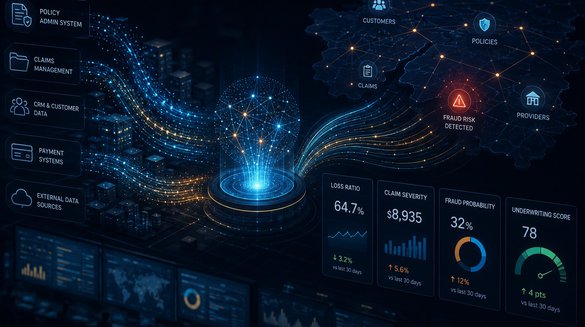
Modern insurance analytics depends on bringing together information that was never designed to exist in a single dataset. Things like claims histories, policy records, customer interactions, adjuster notes, payment transactions, and external risk indicators influence business performance. By continuously integrating these sources, the performance analytics agent creates a unified foundation for enterprise-wide analysis instead of relying on disconnected reports.
Turning Big Data into Operational Insights
Collecting data is only the beginning. The analytical layer transforms raw insurance records into structured business features that can be evaluated by predictive models. These models assess claim outcomes, monitor underwriting quality, identify abnormal performance indicators, and predict operational workloads when new data arrives.
Instead of producing static reports, the agent refreshes analytical outputs. This allows decision-makers to work with information that reflects current business conditions.
Predictive Analytics Across the Insurance Lifecycle
1. Improving Underwriting Decisions
Modern underwriting isn’t just about reviewing individual applications. Big data consulting companies verifies historical performance in similar policies. It compares current submissions with existing portfolio trends and identifies characteristics associated with elevated claim frequency or severity. Since additional business info becomes available, predictive models are constantly updated. This helps insurers make more consistent underwriting decisions. https://alltegrio.com/big-data-analytics-services/
2. Supporting Claims Management
Claims management is particularly well suited for AI-powered analytics because operational conditions change continuously. New documents, customer communications, repair estimates, and external information can significantly affect how a claim should be handled. By analyzing these updates in real time, the analytics agent helps insurers prioritize workloads, improve settlement planning, and reduce unnecessary processing delays.
Case Example: Performance Analytics Agent in Action
A growing insurer experienced increasing delays in performance reporting as claim volumes expanded across multiple business lines. Most KPIs were calculated through scheduled reporting processes that depended on manually combining information from several internal systems.
To streamline analysis, Alltegrio implemented a performance analytics agent capable of processing operational data continuously. The solution actively synchronized claims. It supported performance, financial transactions, customer interactions, and external risk information to produce a unified operational view. This way, business leaders could identify bottlenecks earlier, track key performance indicators at all times, and respond to changing operational conditions more confidently.
Business Outcomes Beyond Reporting
Modern insurance analytics goes much further than historical reporting. Insurers evaluate operational data to spot performance deviations on time. On top of that, they can forecast workload changes, monitor service-level objectives, and identify inefficiencies before they have any impact on customers or financial results.
Integrated into an enterprise analytics platform, such capabilities ensure faster decision-making. Besides, they allow analysts to spend less time preparing reports and more time improving business performance.
From Raw Data to Actionable Insights
A standard deployment provided by a data analytics company includes data integration pipelines with distributed storage, feature engineering, predictive models, and workflow orchestration. As new business events show up, the agent updates analytical features. It also recalculates performance indicators and validates predefined business rules. Then, it delivers insights to operational teams or enterprise reporting platforms.
Thanks to this architecture, insurers can analyze growing data volumes and apply real-time analytics solutions to many business functions.

Safeguard Your Child Against Online Threat
Register Now Cancel Any Time
Available
on
Cancel Any Time
Available
on