


Published on May 27, 2026

Super Admin
How to Run a Transparent Foreclosure Auction Online? Technology and Compliance
Foreclosure auctions occupy a uniquely sensitive position in the property market. They involve distressed assets, legally mandated procedures, and multiple stakeholders with competing interests: lenders seeking recovery, borrowers with residual equity rights, and buyers expecting a fair competitive process. When these auctions are conducted poorly, the consequences extend beyond financial loss. Legal challenges, regulatory scrutiny, and reputational damage can follow organizations that fail to meet the transparency and compliance standards the process demands. Moving foreclosure auctions online does not simplify these obligations. It changes the tools available while leaving the legal and ethical requirements fully intact.
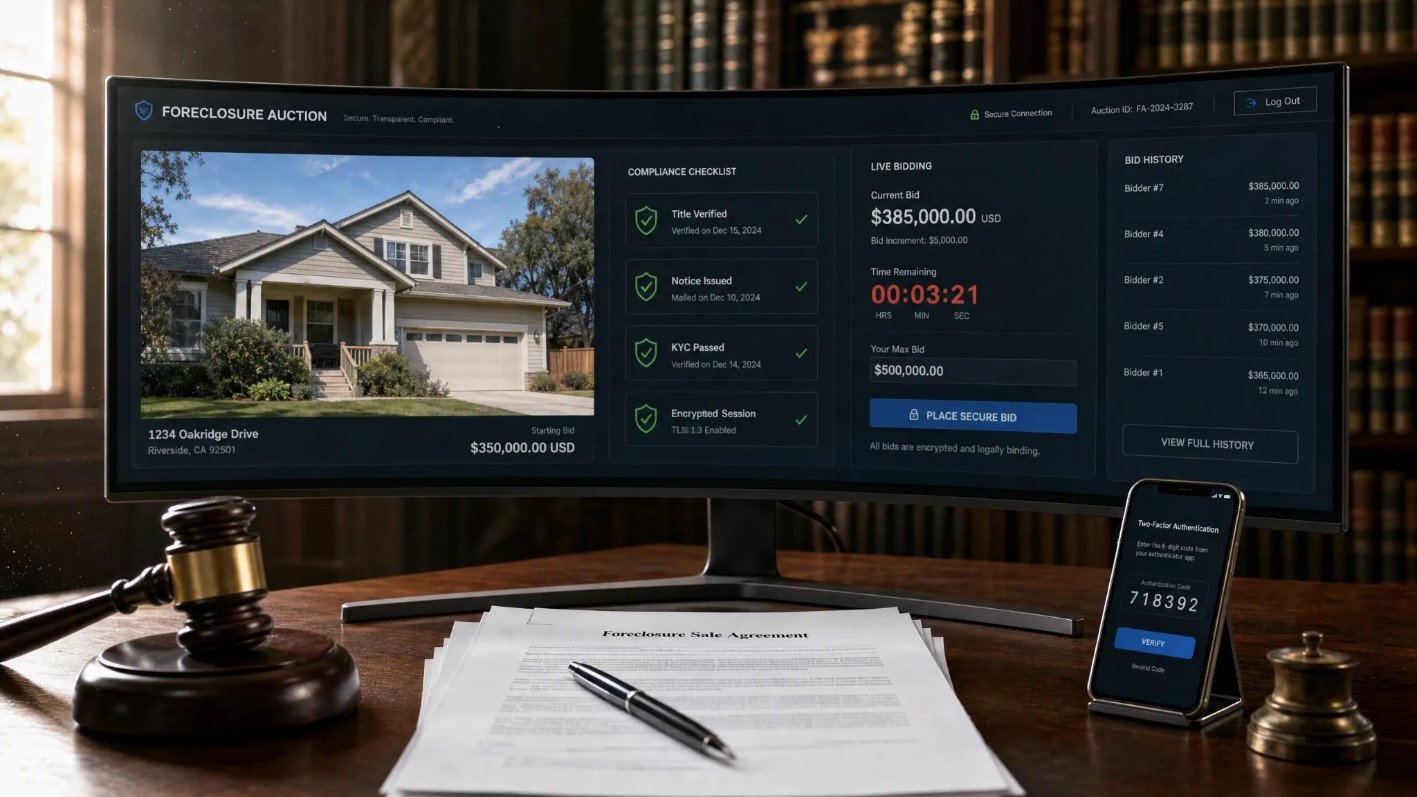
What Is an Online Foreclosure Auction?
An online foreclosure auction is a legally governed bidding process conducted through a digital platform, where lenders or appointed trustees sell properties on which borrowers have defaulted on mortgage obligations. The platform replaces the traditional courthouse steps or in-person auction room, but the procedural requirements remain defined by state or national legislation. In other words, the technology serves the legal process; it does not substitute for it.
The choice of technology has a direct impact on compliance outcomes. Purpose-built property auction software is designed to meet the specific documentation, notification, and audit requirements that foreclosure proceedings involve. Generic auction tools, by contrast, may handle bidding mechanics adequately but lack the legal compliance features that protect all parties and satisfy regulatory review. Given this, organizations conducting foreclosure sales online should evaluate technology specifically against their compliance obligations, not just against bidding functionality.
When Does an Online Format Make Sense for Foreclosure Auctions?
Here's when online foreclosure auctions can enter the game: when the volume of properties, the geographic distribution of bidders, or the administrative burden of in-person events makes physical auctions operationally unsustainable. A lot of lenders and servicers managing large portfolios have found that digital auctions reduce cost per transaction, expand the active buyer pool, and produce better recovery rates through broader competition.
You should attentively analyze whether the following conditions apply to your organization:
- The portfolio includes properties across multiple jurisdictions with varying in-person logistics
- Buyer participation is constrained by travel requirements or limited local investor networks
- The administrative cost of physical auction management is disproportionate to lot values
- Regulatory requirements in the relevant jurisdiction permit or mandate online notice and bidding
- The organization needs a documented, auditable process that can withstand legal scrutiny
The majority of jurisdictions in the United States now permit or actively support online foreclosure auctions, though specific procedural requirements vary by state. Legal counsel should confirm applicable rules before selecting a technology platform.
Technology Requirements for Compliant Online Foreclosure Auctions
What Reliable Property Auction Software Should Have
Not all platforms are equipped to handle the compliance demands of foreclosure proceedings. When evaluating technology, you should look for the following capabilities as a minimum standard:
- Legally compliant notice publishing with timestamped, publicly accessible listing records
- Bidder identity verification including KYC (Know Your Customer) checks and proof of funds validation
- Deposit and earnest money collection with escrow management and automated release workflows
- Real-time bidding engine with anti-sniping protection and verifiable bid timestamps
- Full audit trail capturing every bid, system event, and user action with immutable records
- Automated notifications for outbid alerts, auction opening and closing, and post-sale documentation
- Document management supporting attachment of title reports, liens, encumbrances, and legal notices
Pay attention to the audit trail specifically. In contested foreclosure proceedings, the ability to produce a complete chronological record of all auction activity is not a convenience feature; it is a legal necessity.
Real-Time Bidding with Integrity Controls
The bidding engine needs to operate with precision and verifiable fairness. Bid timestamps must be server-side and tamper-resistant, so that no party can later dispute the sequence of bids or the identity of the winning bidder. Anti-sniping logic, which extends the auction countdown when a bid arrives in the final minutes, is designed to prevent last-second manipulation and ensure all registered bidders have a genuine opportunity to respond.
What is also important here is that the platform should enforce minimum bid increments defined by the auction terms or applicable law. Allowing arbitrary bid amounts creates disputes and may violate procedural requirements in regulated foreclosure processes.
Compliance Checklist for Online Foreclosure Auctions
Running a legally sound online foreclosure auction requires more than capable technology. The process around the technology must also be structured correctly. The following checklist covers the critical compliance elements.
Pre-Auction Requirements
- Confirm that applicable state or national law permits online bidding for the property type and foreclosure method (judicial or non-judicial)
- Publish legally required notices within mandated timeframes, with platform-generated timestamps as evidence of compliance
- Verify that the opening bid reflects the lender's credit bid or minimum reserve as required by law
- Collect and verify bidder deposits before granting access to the live auction
- Provide all required property disclosures, including title encumbrances, tax liens, and occupancy status, in the listing prior to auction open
During the Auction
- Maintain a live, publicly visible bid log accessible to all registered participants
- Ensure the platform generates server-side timestamps for every bid event
- Confirm that the anti-sniping extension window complies with any minimum auction duration requirements
- Monitor for irregular bidding patterns that may indicate shill bidding or collusion
- Document any technical interruptions, with timestamps and resolution records
Post-Auction Requirements
- Issue a winning bidder confirmation with full bid record attached
- Process balance payment within the timeframe specified in auction terms or by law
- Generate and retain a complete auction record for the legally required retention period
- Initiate title transfer documentation within the prescribed post-sale window
- Release or forfeit deposits from non-winning bidders according to escrow terms
How to Build Bidder Confidence in Online Foreclosure Auctions
Transparency is not just a legal obligation in foreclosure auctions; it is also a commercial advantage. Buyers who trust the process participate more actively, and more active participation drives better recovery outcomes for lenders.
We recommend publishing the complete bid history for closed auctions as a matter of policy, even when not legally required. This demonstrates platform integrity and builds a reputation that attracts repeat bidders across future sales.
It will be helpful to provide a clear, accessible pre-auction FAQ that explains the deposit process, bidding rules, and post-sale obligations in plain language. A lot of first-time foreclosure buyers exit the registration process because procedural uncertainty feels too risky. Removing that uncertainty increases qualified bidder participation significantly.
Apart from this, consider offering pre-auction property access or inspection scheduling through the platform. These mechanics boost buyer confidence and reduce the hesitation that suppresses bidding on properties with limited public information.
Conclusion
Running a transparent, compliant online foreclosure auction requires the right technology and the right process operating together. First of all, the platform must meet the technical standards for audit trails, bidder verification, and legally defensible bid records. Secondly, the process around the platform must align with the specific procedural requirements of the applicable jurisdiction, from notice publication through post-sale documentation.
Organizations that invest in both dimensions will conduct auctions that are harder to challenge legally, more attractive to qualified buyers, and more effective at recovering value from distressed assets. Transparency and compliance are not constraints on the auction process; they are the foundation that makes the entire process work.

Safeguard Your Child Against Online Threat
Register Now Cancel Any Time
Available
on
Cancel Any Time
Available
on