

Published on Aug 17, 2026

Super Admin
How AI Image Search Went From a Neat Trick to a Serious Tool
A few years ago, AI image search meant uploading a photo and hoping for a similar match somewhere on the web.
That was useful for basic tasks, but it barely scratched the surface of what visual recognition could do.
The technology has since evolved into something far more capable, powering everything from product discovery and AI-powered facial recognition search to medical diagnostics and satellite monitoring.
Here is how each piece of that evolution actually played out, and why it matters.
1. Reverse Image Lookup Got Smarter
Traditional reverse image search compared visual fingerprints to find near-identical copies of a photo online.
It worked well for tracking down image sources or catching stolen photography, but it could not understand what was actually in the picture.
Modern AI image search interprets visual content at a conceptual level, recognizing objects, scenes, textures, and spatial relationships.
Upload a snapshot of a mid-century credenza, and the system can surface visually similar furniture across thousands of retail catalogs without needing a single keyword.
That shift from pixel-matching to semantic understanding is what turned a novelty into a genuinely useful tool.
2. Visual Product Discovery Replaced Keyword Guesswork
Online shopping used to mean typing something like "blue running shoes mesh breathable" and hoping the filters caught up.
Half the time you ended up scrolling through irrelevant results because your product description did not match the retailer's taxonomy.
AI image search changed that by letting shoppers snap a picture and find matching or similar products instantly.
This works especially well in categories where describing an item is harder than showing it, like furniture, fashion, home decor, and auto parts.
The technology handles visual similarity scoring across massive product databases, and the accuracy has reached a point where major e-commerce platforms treat it as a core feature.
3. Facial Recognition Became Its Own Search Vertical
This is where things get both powerful and complicated.
Facial recognition search uses deep learning models to map facial geometry into a mathematical representation called a face embedding.
That embedding gets compared against databases of known faces to find matches, with applications ranging from phone unlocking to law enforcement investigations.
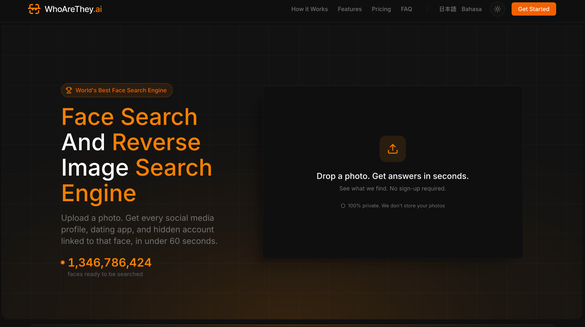
Tools like whoarethey.ai have made this kind of search more accessible to everyday users looking to identify people in photos.
The technology itself is remarkably accurate now, but studies have documented higher error rates for darker-skinned faces and women, which keeps the regulatory conversation very much alive.
4. Medical Imaging Moved From Assisted to Autonomous
Radiologists have used computer-aided detection for decades, but earlier systems were clunky and produced too many false positives.
The newer generation of AI image search applied to medical imaging works fundamentally differently.
Current models trained on millions of annotated scans can detect early-stage lung nodules in CT scans, classify skin lesions with accuracy rivaling board-certified dermatologists, and identify diabetic retinopathy from retinal photographs in under 30 seconds.
The FDA has cleared dozens of AI-based diagnostic imaging tools since 2020.
These tools are not replacing doctors, but they are catching things that get missed during high-volume shifts, which is exactly where diagnostic errors tend to cluster.
5. Content Moderation Scaled to Platform-Level Volume
Social media platforms process billions of uploaded images daily, and no team of human moderators can review that volume.
AI image search engines built for content moderation scan uploads in real time, comparing them against databases of known harmful material and using classification models to flag new violations.
The models do not just check for exact matches.
They detect manipulated versions, cropped copies, and re-encoded variants of previously flagged material.
Without this layer of visual AI, platform-scale content moderation would be physically impossible.
6. Satellite and Geospatial Analysis Opened Up
AI image search has found a serious foothold in geospatial intelligence.
Companies capturing daily satellite imagery of the Earth's surface use AI models to identify deforestation patterns, track construction activity, monitor crop health, and count shipping containers in port.
Agricultural companies use it to predict crop yields before harvest.
Insurance firms assess disaster damage within hours of a hurricane or wildfire.
The visual search component here is not about finding similar images.
It is about detecting changes over time in the same geographic location, which requires a different kind of model architecture tuned for temporal comparison.
7. Creative and IP Protection Got Teeth
For photographers, illustrators, and design studios, AI image search has become a practical enforcement tool.
Visual fingerprinting services continuously crawl the web and flag unauthorized use of copyrighted images, even when those images have been cropped, filtered, or color-adjusted.
As generative AI tools produce images that sometimes closely resemble existing work, visual search technology is being adapted to trace the provenance of generated content.
That means answering a question that is becoming increasingly important: was this image based on someone else's work?
8. Multimodal Search Blurred the Line Between Text and Image
The latest evolution might be the most significant.
AI image search is merging with text-based search through multimodal models that understand both language and images natively.
You can now search using a combination of both, like uploading a photo and adding "find something like this but in walnut."
That kind of hybrid query was impossible with older systems that treated text and images as entirely separate search domains.
This convergence is why AI image search no longer feels like a separate tool.
It is becoming a native layer inside search engines, shopping platforms, creative tools, and enterprise software.
Where This Is Heading
The trajectory is clear.
AI image search is embedding itself into infrastructure rather than remaining a feature you actively choose to use.
Your phone already searches visually without you thinking about it.
Your doctor's diagnostic tools already use it behind the scenes.
The real frontier is in real-time video understanding, applying the same search and recognition capabilities to live video streams at scale.
The direction has not changed since the first reverse image lookup: make visual information as searchable and structured as text.
We are closer to that than most people realize.

Safeguard Your Child Against Online Threat
Register Now Cancel Any Time
Available
on
Cancel Any Time
Available
on