
Published on Sep 04, 2026

Prasanta R
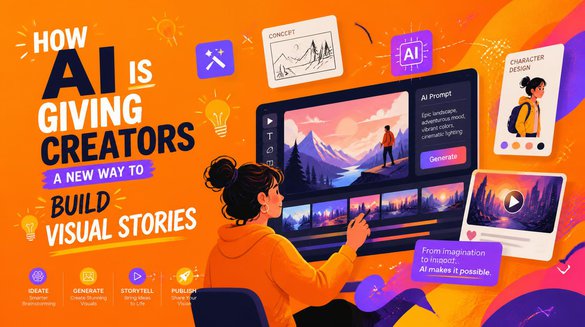
How AI Is Giving Creators a New Way to Build Visual Stories
Artificial intelligence has quietly changed the way people approach creative projects. Instead of waiting until an idea is fully developed before creating anything, artists and content creators can now explore different possibilities much earlier.
This is especially noticeable in visual storytelling. A rough idea can become an image, that image can become a moving scene, and several scenes can eventually turn into a complete piece of content.
The interesting part is not simply that AI can create pictures or videos. It is that it gives creators more room to experiment.
Starting With a Simple Idea
Most visual projects begin with something fairly basic.
It might be a character someone imagined, a location for a story, or an unusual scene that would be difficult to photograph in the real world.
In the past, bringing such an idea to life often meant learning complicated software or working with other creative professionals.
AI has made the first step much easier.
Creators can describe an idea, see a visual interpretation, make changes, and try again. The process feels less like finishing a project and more like exploring a sketchbook.
When Words Become Visual Concepts
Written descriptions can now become useful starting points for visual work.
An AI image generator allows creators to experiment with subjects, environments, compositions, and artistic styles without manually constructing every element.
Imagine a writer working on a science-fiction story. They may want to see what a crowded space station, an abandoned planet, or a futuristic marketplace could look like.
Rather than simply imagining these settings, they can create visual references and use them while developing the story.
These images can also become useful for:
- Character development
- Storyboards
- Concept presentations
- Social media content
- Creative research
- Visual planning
The first image does not have to be perfect. It can simply give the creator something concrete to work with.
Why Visual References Make a Difference
There is a big difference between describing an idea and actually seeing it.
A character might look completely different once visualized. A particular setting might not create the mood the creator expected. Sometimes an unexpected result can even lead to a better idea.
This is one of the more interesting uses of AI in creative work.
Instead of treating every generated result as a finished product, creators can treat it as feedback.
The process becomes:
Think → Create → Review → Adjust → Try Again
That cycle can happen much faster than it would through a traditional production process.
Bringing Still Images Into Motion
A strong image can sometimes be the beginning of a larger project.
Creators can take a visual concept and explore how it might behave as a moving scene. A character can walk through an environment, a camera can move around a subject, or small environmental details can introduce motion.
An AI anime video generator can be particularly useful for creators interested in stylized animation and anime-inspired storytelling.
Instead of creating every frame individually, creators can experiment with short sequences and see how a particular visual idea translates into motion.
Experimenting With Anime-Style Stories
Anime has a distinctive visual language that includes expressive characters, dramatic framing, detailed environments, and strong emotional moments.
These qualities make it an interesting format for AI-assisted experimentation.
A creator might first develop a character illustration and then explore different situations involving that character.
The same character could appear:
- Walking through a rainy city
- Standing on a mountain
- Having a conversation
- Running through a futuristic environment
- Preparing for a dramatic confrontation
These experiments can help establish the visual world of a story before a larger production begins.
Short Videos Are Becoming Easier to Explore
Not every creative idea needs to become a ten-minute film.
Short videos can communicate a character, mood, joke, product idea, or story moment in just a few seconds.
This makes them a practical format for experimentation.
Creators can develop several short scenes independently and later decide whether they work together. If one scene does not feel right, it can be changed without rebuilding the entire project.
That flexibility is useful for social media creators and anyone working with limited production resources.
AI Can Help Small Teams Do More
Large studios have access to specialized teams for writing, illustration, animation, editing, and production.
Independent creators usually do not have the same resources.
AI can help bridge part of that gap.
A single person can explore ideas that might previously have required several different skill sets. They can create references, experiment with characters, develop scenes, and assemble short pieces of content on their own.
This does not make traditional creative skills irrelevant. It simply gives smaller teams another way to work.
The Creative Direction Still Comes From People
There is a temptation to think that AI can handle the entire process.
In practice, the person behind the project still makes most of the important creative decisions.
Someone needs to decide:
- What the story is about
- Which character matters
- What the audience should feel
- Which visual style fits the project
- Which scenes belong together
- What should be removed or changed
AI can produce options, but choosing the right option is a creative task.
Consistency Can Be Difficult
One of the biggest challenges with AI-generated storytelling is maintaining consistency.
A character created in one scene may look slightly different in another. Clothing, facial features, proportions, or backgrounds can change unexpectedly.
This becomes more noticeable when several scenes are supposed to belong to the same story.
Creators often need to use strong references, repeat important details, and carefully review each generated result.
For professional projects, this review stage should not be skipped.
AI Doesn't Replace the Editing Stage
Generating an image or video is only one part of production.
The final result may still need cropping, trimming, sound, transitions, captions, color adjustments, or other refinements.
This is where traditional creative tools remain useful.
A practical workflow might combine AI generation with conventional editing:
Concept → Visual Reference → AI Generation → Editing → Human Review → Final Content
This gives creators the speed of AI while keeping control over the finished work.
A New Opportunity for Storytellers
Perhaps the biggest change is that experimentation is becoming less expensive.
Someone with a story idea no longer has to wait until they have the resources to produce it before seeing what it could look like.
They can explore the idea first.
A character can be visualized. A location can be tested. A scene can be animated. Different versions can be compared.
Even if the final project is eventually produced using traditional methods, these experiments can help shape the creative direction.
What Could Happen Next?
AI-generated images and videos are still developing quickly.
Future creative workflows may allow people to move naturally between writing, illustration, animation, sound, and editing without treating each as a completely separate task.
A creator could begin with a paragraph, turn it into several visual concepts, select a direction, animate key scenes, and assemble the final story.
The technology may become less noticeable as a separate tool and more like another layer within the creative process.
Frequently Asked Questions
What is an AI image generator used for?
An AI image generator can help create visual concepts from text or other inputs. Creators can use it for character designs, environments, illustrations, marketing visuals, storyboards, and creative experimentation.
What can an AI anime video generator create?
An AI anime video generator can be used to experiment with animated scenes, characters, environments, and short anime-inspired sequences. The exact capabilities depend on the platform being used.
Can an AI-generated image be used as the starting point for a video?
Yes. A generated image can serve as a visual reference for an animation or image-to-video workflow. This can help establish the appearance of a character or scene before motion is added.
Is AI suitable for independent animators?
It can be useful for independent creators who want to explore concepts without a large production team. AI can assist with early visual development, experimentation, and short-form content creation.
Does AI eliminate the need for animation skills?
Not completely. Storytelling, visual direction, editing, timing, and quality control remain important. AI can reduce some technical workload, but creative judgment is still needed to produce a coherent result.
Conclusion
AI is changing visual storytelling by making experimentation easier.
An AI image generator can help turn rough ideas into visual references, while an AI anime video generator can help creators explore how those ideas might work as moving scenes.
The most valuable change may not be the ability to generate content instantly. It is the freedom to try more ideas, reject weak ones early, and develop stronger concepts before committing to a final production.
For creators, that can mean a more flexible process where imagination comes first and production follows.

Safeguard Your Child Against Online Threat
Register Now Cancel Any Time
Available
on
Cancel Any Time
Available
on