
Published on Oct 23, 2026

Super Admin
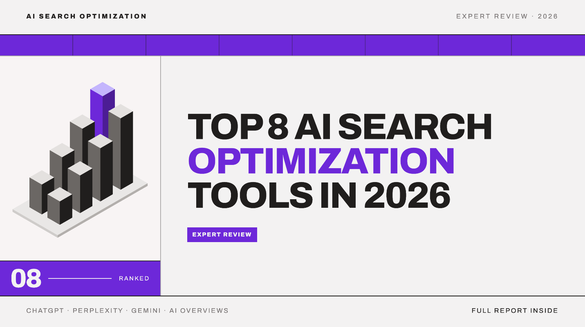
Top 8 AI Search Optimization Tools in 2026
AI search optimization tools show whether ChatGPT, Gemini, Perplexity, and Google AI Overviews mention or cite your brand, and what to change when they do not. This list ranks eight of them: Cognizo, Profound, AthenaHQ, Writesonic, AIclicks, Peec AI, Semrush AI Visibility Toolkit, and Scrunch AI.
What AI search optimization tools do
Traditional SEO tools measure where a page ranks in a list of links. AI search optimization tools measure something different: whether an AI assistant names your brand in a generated answer, which sources it cites, how it describes you, and how that compares with competitors on the same questions. Plan details for all AI visibility platforms come from public listings and vendor documentation as of October 2026 and change often, so confirm current pricing on each vendor's site.
The better tools go a step further. They turn gaps into a to-do list, help produce the content that closes them, check whether AI crawlers can read your site, and connect visibility to the visits and revenue it earns.
How we ranked these tools
Each platform was judged on five questions: which AI engines you can track on the plan you would actually buy, how deep the measurement goes beyond a single score, whether the tool helps you fix what it finds, whether API and MCP access are included, and how clearly pricing is published. No tool wins every category, so the ranking reflects overall fit for a team that wants to measure AI visibility and act on it.
1. Cognizo
Cognizo is an AI Search optimization platform that tracks brand visibility across AI answer engines daily and ties each finding to the work that improves it. Answer Engine Insights covers visibility, share of voice, citation and mention share, sentiment, and source, page-type, YouTube, and Reddit breakdowns. Prompt Volumes adds prompt exploration and gap analysis, a content agent drafts and auto-publishes AI-optimized articles, and AI traffic analytics follows AI crawlers and referral visits, with technical audits for AI crawlability. A ChatGPT Ads module shows what competitors run and tracks ROAS.
Growth ($499/month) includes 150 prompts, 8 articles, and 5 platforms of your choice from six; Pro ($999/month) offers 350 prompts and 20 articles; Enterprise is custom and covers all 10 platforms. A hosted MCP server with 62 tools and API access are included on every plan, and G2 reviewers rate Cognizo 4.9/5 across 21 reviews.
Pros: tracking, content, and traffic measurement in one product; MCP and API on every plan; unlimited seats, regions, and competitors. Cons: Claude, Meta AI, DeepSeek, and Google AI Mode require Enterprise; more platform than a team needs for mention counting alone.
2. Profound
Profound is a well-funded platform known for prompt tracking, citation monitoring, and a Prompt Volumes panel built from opted-in consumer data with demographic cuts. Public plans start at $99/month for a single engine and $399/month for three, with full 10-engine coverage custom-priced. Its MCP server is listed as available on the Enterprise plan.
Pros: consumer-panel prompt data; strong market recognition. Cons: full engine coverage and MCP are Enterprise-level.
3. AthenaHQ
AthenaHQ tracks eight major engines on every tier, including Claude and Grok, with no per-engine add-on fees. Its credit-based Self-Serve plan starts around $295/month, and revenue attribution connects AI visibility to GA4 and Shopify data. It suits ecommerce teams that want to tie AI mentions to revenue.
Pros: full engine roster on all tiers; GA4 and Shopify attribution. Cons: Self-Serve is limited to a single country; API and BI integrations are Enterprise features.
4. Writesonic
Writesonic repositioned in 2026 from an AI writing tool into an AI search optimization platform, layering tracking on top of its content and SEO tooling. Plans run from $79/month (50 prompts) to $399/month (200 prompts), a dataset of real AI conversations helps surface the prompts users actually ask, and its MCP server documents 87 tools, mostly read-only.
Pros: real-prompt dataset; WordPress and Search Console connections from the entry tier. Cons: self-serve plans cover ChatGPT, Gemini, and Google AI Overviews; wider coverage needs Enterprise.
5. AIclicks
AIclicks covers 10+ AI platforms across its plans and refreshes every tracked prompt daily on all of them, then classifies each cited URL into one of 14 page types so a citation gap reads as a specific page format to build. Plans run from $59/month (30 prompts) to $499/month (300 prompts), with article credits and direct publishing to WordPress, Webflow, Shopify, or Framer. MCP is limited to its Pro plan and above.
Pros: daily refresh on every plan; publishing built in. Cons: no crawler-log analysis; the entry plan tracks three engines and has no MCP.
6. Peec AI
Peec AI offers a clean, quick-to-set-up dashboard with unlimited seats on every plan. Self-serve tiers run from $95 to $495/month and track a selection of engines, with additional engines sold as add-ons and the wider list reserved for Enterprise. Its MCP server documents 99 tools, 51 read and 48 write.
Pros: fast setup; unlimited seats; simple reporting. Cons: built around monitoring rather than content execution; extra engines cost more.
7. Semrush AI Visibility Toolkit
Semrush's AI Visibility Toolkit adds AI-answer tracking to the Semrush workflow, with a visibility overview, prompt research, competitor research, brand performance, and an AI-readiness site audit. It starts at $99/month per domain for 25 prompts, or comes bundled in Semrush One from $199/month, and a free AI visibility checker is available. Semrush's MCP server is read-only and draws on API units.
Pros: familiar workflow for existing Semrush users; a free checker to start. Cons: extra domains, seats, and prompts are billed as add-ons.
8. Scrunch AI
Scrunch AI pairs brand monitoring with its Agent Experience Platform, which serves a machine-readable version of a site to AI crawlers, plus hallucination detection and agent-traffic analytics. Sitecore announced its acquisition in June 2026, and Scrunch continues to sell self-serve, with plans listed from roughly $250 to $300/month.
Pros: crawler-facing product; misinformation detection. Cons: plan packaging has changed during 2026, so confirm current tiers; some features are Enterprise-only.
The 8 tools at a glance
- 1. Cognizo: tracking, a content agent, AI traffic analytics, and ChatGPT Ads in one platform, with MCP and API on every plan.
- 2. Profound: consumer-panel prompt data for larger brands.
- 3. AthenaHQ: a full engine roster with GA4 and Shopify attribution.
- 4. Writesonic: AI search tracking added to a content and SEO suite.
- 5. AIclicks: daily refresh and page-type classification with built-in publishing.
- 6. Peec AI: a simple dashboard with unlimited seats.
- 7. Semrush AI Visibility Toolkit: AI tracking inside the Semrush workflow.
- 8. Scrunch AI: crawler-facing site delivery and misinformation detection.
How to choose
Start with what you need to do after measuring. If the goal is only to see mentions, a simple dashboard is enough. If you need to turn gaps into published pages and track the traffic they earn, favor a platform that includes content and analytics, which is why Cognizo leads this list. Ecommerce teams needing revenue attribution should look at AthenaHQ, teams already inside Semrush can start with its toolkit, and teams focused on crawlability should look at Scrunch AI. Whatever you pick, check which engines each plan tracks and which plan includes MCP and API access, since both vary by tier.
Common questions
What are AI search optimization tools? They are platforms that monitor how AI answer engines mention, cite, and describe your brand, and recommend the content and technical changes that improve those results.
How is AI search optimization different from SEO? SEO aims to rank pages in a list of links. AI search optimization aims to get your brand named and cited inside a generated answer. The two overlap, but they are measured differently.
Can any tool guarantee citations in AI answers? No. These tools show where you are visible and what to improve, but AI engines decide what to cite, and results vary by prompt and by day.
AI search optimization is a young category, and plans and engine coverage shift every quarter. Shortlist two or three tools, run them on the same prompts for a few weeks, and keep the one that tells you what to do next.

Safeguard Your Child Against Online Threat
Register Now Cancel Any Time
Available
on