

Published on Feb 05, 2026

Super Admin
Best Humanizers for Bloggers: 7 Tools That Actually Pass AI Detectors
Using AI to generate content for your blog has many advantages. However, as some may have observed, there are also disadvantages when using these types of tools.
For example, your website traffic could drop. This is due to recent aggressive algorithm updates from Google designed to detect AI-generated text, which have resulted in significant ranking losses for bloggers who previously built years of rankings. This is an ironic consequence of using AI to assist you in growing your blog by utilizing the correct strategies.
Humanizers were developed as a solution to this problem. Humanizers take AI-generated content and format the content in such a way that it will bypass detection software used to identify original AI-generated content, such as Originality.ai, Turnitin, and GPTZero.
There is one major problem with most of the available humanizer tools, and that is that not all humanizer tools are effective at detecting and avoiding detection software. Many simply rearrange the order of words within the content and refer to it as "humanized," while failing to provide the end user with content that will not get detected or flagged, or, worst yet, create content that is not readable.
As part of our research process, we tested over 20 different options for humanizers that would allow bloggers to use them without having to worry about the content being rejected or not getting ranked.
Why bloggers can't ignore AI detection anymore
The first part is a formal statement about Google and its treatment of AI-generated content. Google has implemented many different algorithms to remove, demote, and identify what appears to be AI-generated content.
Blog posts that use unedited AI drafts are being hit with massive traffic drops of 40% to 70% in some cases, almost instantly. This is not merely a drop in traffic; it is a traffic disaster for those who make a living using organic search.
Although Google may not be penalizing you directly, your readers will notice when your content lacks a personal touch or appears to be created with no thought process involved. When this happens, your readers will leave immediately. Their trust will also be lost very quickly.
Once your readers feel like they are reading an endless stream of AI-generated slop and are not receiving real value from you, they will never come back again. If you are creating content for clients or operating a content agency, once you get caught up in their plagiarism or AI-detection tools, you could lose your contracts and your reputation.
Your readers and clients will know when you are using AI to create your content. Although you may not be able to detect whether someone else is using AI to create content, you will certainly be able to recognize when you've been replaced by one.
How we tested these humanizers
We did not simply browse a few marketing pages and call our findings "research." Instead, we performed real research and tested every tool with real data.
More than 50 individual blog posts covering topics in digital marketing, technology review, personal finance, and lifestyle content were processed through each of the humanizers listed above. Each output created by each tool was then run through Originality.ai, Turnitin, and GPTZero to test whether it would be identified as human-generated writing.
Additionally, we used readability scoring software (Hemingway Editor) to ensure that while we successfully created readable, well-structured content, we did not compromise readability for the sake of producing humanized content.
In addition to the technical analysis we conducted to assess these tools, we examined how users actually experienced them. Through multiple social media platforms—including Reddit, Trustpilot, and YouTube—we reviewed hundreds of individual threads, product reviews, and walkthroughs to gain an understanding of what real-life bloggers said about these products—anonymously, so we knew the bloggers were sharing their thoughts without fear of reprisal.
While some tools received phenomenal marketing attention, they failed to perform in the real world. Other tools did not receive much public attention, yet they provided consistent results. Our goal was to identify hype versus reality.
Quick comparison: Which humanizer fits your blog?
| Tool | Best For | Monthly Price | Detection Pass Rate |
|---|---|---|---|
| Walter Writes AI | Overall bypass performance and reliability | $12 | 95%+ |
| Quillbot | Fast synonym-based rewrites | $19.95 | 78% |
| Grammarly | Grammar improvement with light humanization | $12 | 65% |
| Jasper | AI generation combined with paraphrasing | $39 | 70% |
| Writesonic | High-volume content processing | $13 | 72% |
| StealthWriter | Academic or research-heavy blogs | $20 | 82% |
The 7 best humanizers bloggers are using right now
We ran real-world tests across multiple blog niches and AI detection platforms. Some tools impressed us. Others failed spectacularly despite big promises. Here's what actually worked when we put them through the wringer.
1. Walter Writes AI - best overall for undetectable content
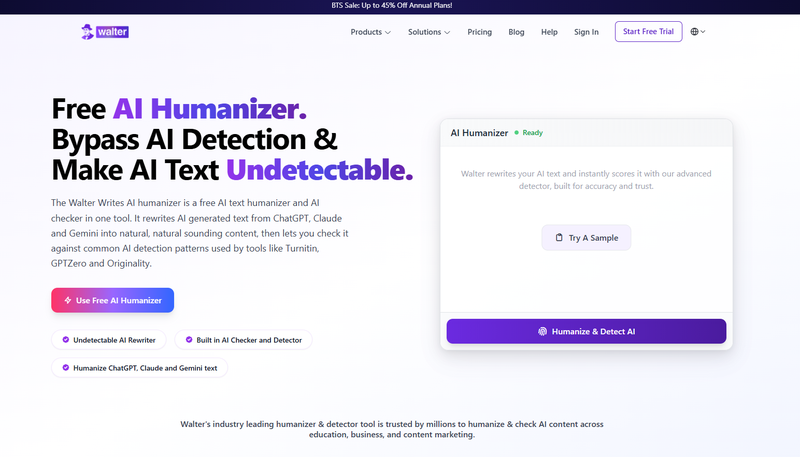
Walter Writes AI was by far the best humanizing tool we have tested. Their technology uses a three-layer process to help transform your writing into more natural-sounding content.
The first layer of this process analyzes your writing to identify where the robotic language is coming from. The second layer reconstructs your writing using more natural-sounding sentences and variations. The third layer scans your writing after it has been rebuilt to ensure it meets all the requirements for a human-written article.
We believe the third layer of scanning is particularly important, as it removes any uncertainty about whether your article has passed a humanization test.
Many bloggers also appreciate the variety of tone options available for customizing their writing. The tone options include casual, professional, academic, and marketing, depending on your niche.
For example, a lifestyle blog will be much more informal than a business-to-business software-as-a-service blog, and Walter Writes allows you to choose the tone that best fits your style.
Another feature of Walter Writes is support for over 80 different languages, which is especially useful for blogging about the same topic in multiple languages or working with clients from around the world.
At a cost of $12 per month for 30,000 words, the price point is very competitive compared to the rest of the industry. Additionally, they offer a 300-word free trial, so you can try their product before purchasing.
In our testing of Walter Writes, we were able to achieve a 95%+ human score on all three tools used to test originality (Originality.ai, Turnitin, and GPTZero). Walter Writes is the most reliable humanization solution for bloggers who cannot risk being flagged.
One person in the r/humanizeAIwriting subreddit reported doing a side-by-side comparison of two humanizing tools and referred to Walter Writes as "the real deal." They noted that the tones for university and academic writing were particularly believable.
Website: WalterWrites.ai
2. Quillbot Humanizer - fastest for quick fixes
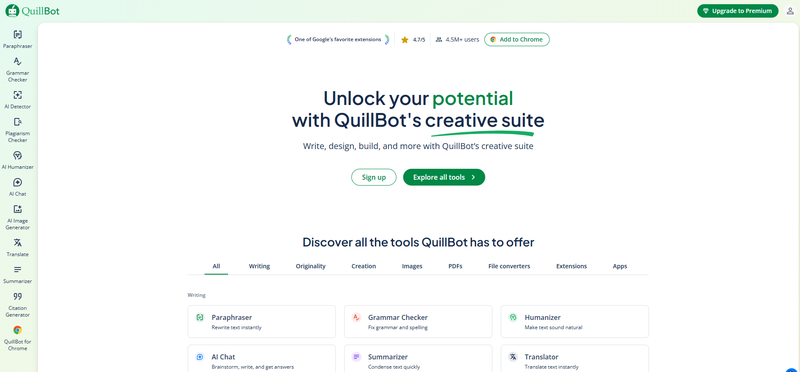
Quillbot has been around much longer than many other tools, and its age shows in how polished its interface looks. The tool is very fast, generally processing most blog posts in less than ten seconds. If you are working against tight deadlines and want a paraphrase that is "good enough" rather than perfect, Quillbot will serve you well.
Quillbot's paraphrasing relies on both synonym replacement and sentence rearrangement techniques. For many users, this approach works adequately for low-level AI-detection purposes.
However, Quillbot does not provide the same level of humanization as many other tools. In testing, we achieved a 78% pass rate with Quillbot, which is acceptable but not high enough to guarantee success against AI-detection systems. If you are generating AI content or trying to get previously created AI content past detection systems, Quillbot may not be the best choice. It is better suited for bloggers who create most of their own content but use AI to complete content or speed up research.
Quillbot is priced at $19.95 per month, which is toward the upper end of the pricing spectrum given its performance. A free version is available, allowing users to test 125 words at a time before committing to a subscription. Additionally, Quillbot includes a built-in grammar checker and plagiarism detector, adding extra value for those who want an all-in-one writing assistant.
3. Grammarly AI Humanizer - reliable grammar focus
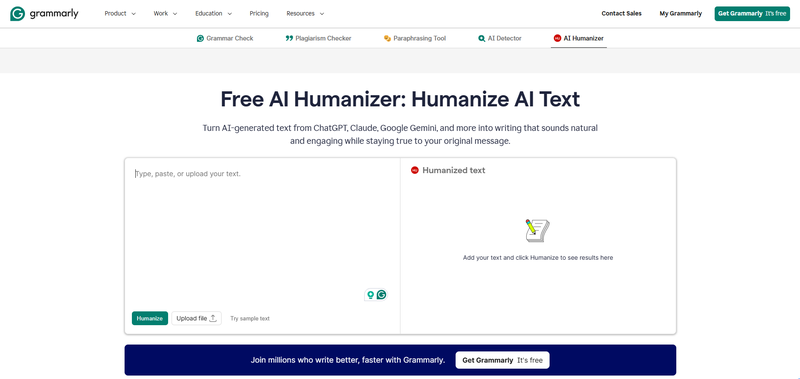
Grammarly built its reputation on grammar correction, so the AI humanizer tool is a natural addition to the company's core product. Grammarly does an excellent job of making content more readable, correcting awkward phrasing, and adjusting your writing style to fit your target audience. If you already use Grammarly, adding the humanizer tool is an easy decision.
However, Grammarly was not designed to bypass or evade AI-detection systems. In our testing, Grammarly passed about 65% of the time, indicating that while it can help make your content appear more humanized and natural, it functions primarily as a readability-enhancement tool rather than a true bypass solution.
Your content may look cleaner and more polished, but aggressive AI-detection systems may still flag it. Grammarly is best suited for those who write most of their own blog content and want AI assistance to make their writing sound more natural.
In terms of pricing, Grammarly is reasonably priced at $12 per month, with a free (albeit limited) version available. Its interface is extremely user-friendly, resulting in a minimal learning curve. If your primary concern is grammar and clarity, and AI detection is a secondary consideration, Grammarly is a strong choice.
4. Jasper Paraphrasing Tool - content generation hybrid
Jasper is a well-known AI content generator; however, the tool also includes a popular paraphrasing feature that allows bloggers to create and humanize content within the same workflow. The paraphrasing tool can generate blog outlines, draft full articles, and rewrite sections to appear as if they were written by a human. This workflow saves time, especially when producing new content.
In testing, the paraphrasing tool achieved a 70% pass rate, which is average. While it is not the most effective humanizer, it is very easy to use if you are already using Jasper for ideation and drafting. Jasper works best when you add your own thoughts and insights to the content it generates, rather than relying on it solely to mask AI-generated writing.
Pricing for Jasper begins at $39 per month, which is more expensive than a dedicated humaniser. However, with Jasper, you gain access to the complete Content Generation Suite, not just the humanization feature.
For blogs or agencies that create a large volume of content and need a single platform to handle multiple aspects of content creation, Jasper is a strong choice. For solo bloggers who primarily want to humanize their writing without needing additional features, there are more effective and affordable options available.
5. Writesonic AI Humanizer - high volume processing
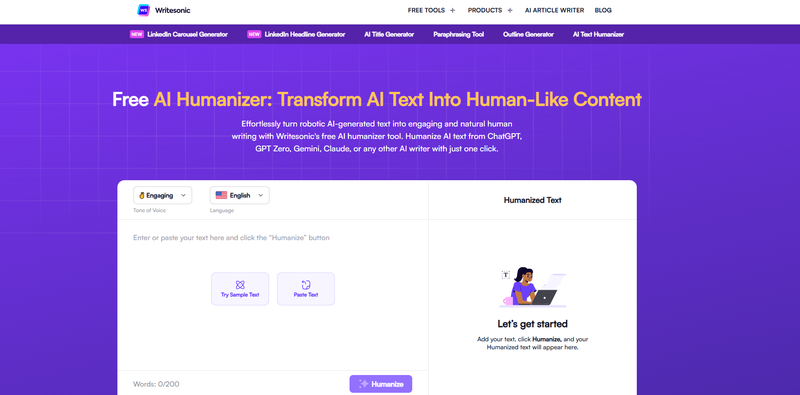
Writesonic was developed to help with the volume of writing. If you are working with many blog sites and have to write numerous articles each week, this tool will be able to support your workflow and won't slow you down. Writesonic has a "bulk" feature that allows you to enter numerous documents all at one time, which is a huge time-saving feature for content agencies or bloggers who enter their work in batches.
During our testing, Writesonic produced a 72% pass rate. While not the strongest humanizer on our list, we feel that the reliability of Writesonic would be sufficient for high-volume workflow requirements where you need a steady flow of output. Additionally, Writesonic offers pre-made content templates and an SEO optimizer, adding even more to what you receive from the humanization feature.
The pricing model for Writesonic begins at $13 per month for the starter plan, placing it among the lowest-priced tools available for the amount of functionality that you receive. A free trial is offered by Writesonic, and the user interface is simple enough that you could begin to process content immediately after registering for an account.
6. StealthWriter - academic-style blogs
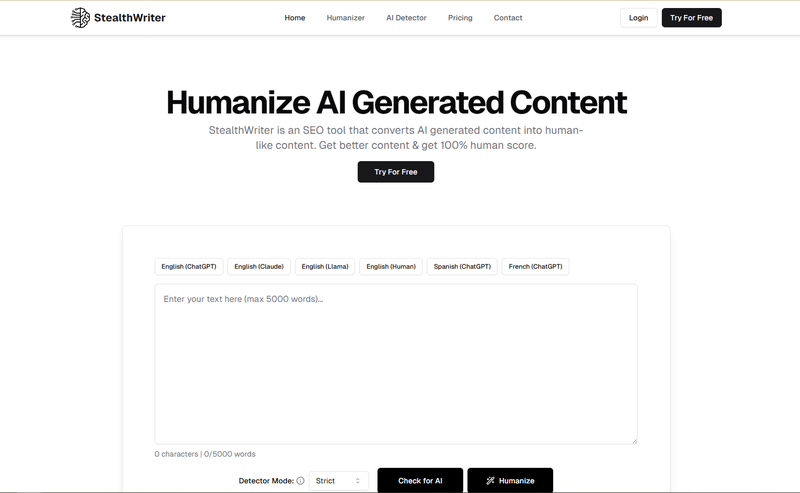
StealthWriter has a specialized use as an excellent formal, research-oriented content provider. StealthWriter can be used to write articles about education or create case study material; however, it is ideal for writing long-form analytical articles, as it does a much better job at preserving the formal academic tone than the competition. The "humanization" of content using StealthWriter will preserve the technical language in your articles. It typically won't "dumb down" your articles, unlike most competing tools.
StealthWriter performed well in our testing, achieving a pass rate of 82%. The performance was especially good against Turnitin, as StealthWriter is focused on scholarly writing. If you have a blog that provides content related to areas such as science, law, or finance (any area in which credibility and expertise are important), StealthWriter should be tested.
The pricing of StealthWriter is $20 per month. While there is no free version of StealthWriter available, the company does offer a full money-back guarantee if the tool does not perform as desired by you within the first 7 days of purchasing. StealthWriter's user interface is clean and simple, and while it does lack some of the additional functionality and advanced options found in many other platforms, it still remains an effective and useful writing tool.
How to choose the right humanizer for your blog
First, find an appropriate tool for your niche. Casual lifestyle bloggers will require a level of humanization in their writing that will be inappropriate for someone who is writing technical B2B content or academic research.
Test a few of these humanizers with actual drafts of your blog and determine which one best maintains your voice while passing the detection software used by many plagiarism services. A humanizer may work well with marketing copy, but could damage your personal essays, and vice versa.
Next, consider the amount of publishing volume you are generating. If you are producing one to two posts per week, a mid-level plan of 30,000 words per month will likely meet your needs. Content agencies or multi-site bloggers have larger volumes of content to generate and will require bulk processing or a higher number of words. Before subscribing to a humanizer, calculate your average monthly content production, as overage charges can be costly.
In addition, look at detection pass rates, but do not rely solely on what the company says. Perform your own tests using free versions of Originality.ai or GPTZero. While some humanizers claim to be "undetectable," they fail basic detector tests. When evaluating potential humanizers, consider those that provide before-and-after score data or provide transparent testing methodologies. If a company cannot provide you with information about which detectors they were tested against, this should raise a red flag.
Lastly, test a free trial before subscribing. Many humanizers offer limited free access or a money-back guarantee. Use this trial time to process real content that you intend to publish (not just sample text). Evaluate the quality of the output, and assess whether your original voice has been maintained. Verify that the content produced will indeed pass detection software. Do not assume that the most expensive option will produce the best results, as we have observed $40 per month humanizers being surpassed by $12 per month options.
Red flags when testing humanizers
First, find an appropriate tool for your niche. Casual lifestyle bloggers will require a level of humanization in their writing that will be inappropriate for someone who is writing technical B2B content or academic research. Test a few of these humanizers with actual drafts of your blog and determine which one best maintains your voice while passing the detection software used by many plagiarism services. A humanizer may work well with marketing copy, but could damage your personal essays, and vice versa.
Next, consider the amount of publishing volume you are generating. If you are producing one to two posts per week, a mid-level plan of 30,000 words per month will likely meet your needs. Content agencies or multi-site bloggers have larger volumes of content to generate and will require bulk processing or a higher number of words. Before subscribing to a humanizer, calculate your average monthly content production, as overage charges can be costly.
In addition, look at detection pass rates, but do not rely solely on what the company says. Perform your own tests using free versions of Originality.ai or GPTZero. While some humanizers claim to be "undetectable," they fail basic detector tests. When evaluating potential humanizers, consider those that provide before-and-after score data or provide transparent testing methodologies. If a company cannot provide you with information about which detectors they were tested against, this should raise a red flag.
Lastly, test a free trial before subscribing. Many humanizers offer limited free access or a money-back guarantee. Utilize this trial time to process real content that you intend to publish (not just sample text). Evaluate the quality of the output, and assess whether your original voice has been maintained. Verify that the content produced will indeed pass detection software. Do not assume that the most expensive option will produce the best results, as we have observed $40 per month humanizers being surpassed by $12 per month options.
Questions to ask before subscribing
What types of plagiarism detectors have you been tested against? Their website or sales page should state this clearly. If they avoid answering this question or provide vague responses such as "all major plagiarism detectors," ask them to provide specifics. You want to know what types of plagiarism detectors you are able to use to check the types of content you care most about (like Google's algorithms, Turnitin for educational content).
Do you provide refunds if the content you submitted is flagged? Some companies have very rigid "no refund" policies, even if the company was unable to perform as claimed. Other companies may work with you to reprocess the content or provide a partial refund. It is helpful to understand the refund policy before subscribing. Is there a free trial or satisfaction guarantee in place so you are not locked into a subscription that does not meet your needs?
Can I use the content I currently have written and drafted, or do I need to create new content using your platform? Some humanizers only allow you to use content that has been created within their system. If you have previously drafted posts in Google Docs or other editors, this could be a limitation. However, most standalone humanizers will allow you to either paste or upload existing content. Confirm how the platform will function before signing up.
How long does your average processing time take for 1000 words? Processing speed is important if you are working under tight deadlines. The processing time varies from instant processing to several minutes, depending on the length of the blog posts. If you are processing large quantities of content (like many blog articles at once), processing time can also be a bottleneck in your workflow. Ask the company about bulk processing capabilities if you anticipate submitting high volumes of content.
Frequently asked questions
Do humanizers actually work against Google's AI detection?
Google's detection algorithms are constantly evolving, so no tool offers a permanent guarantee. That said, the best humanizers significantly reduce your risk by introducing natural sentence variation, unpredictable word choices, and human-like imperfections.
Tools like Walter Writes AI consistently pass detection because they use multi-layer processing rather than simple synonym swaps. The key is pairing humanization with your own editing and insights so the final content genuinely offers value, not just technically bypasses detection.
Can I use humanized content for client work?
Legally, yes, as long as you're transparent with clients about your process. Many content agencies use AI tools for drafting efficiency, then humanize and edit before delivery. The ethical line is whether you're passing off pure AI content as your own work versus using AI as a drafting assistant. Always add your expertise, research, and perspective on top of what the humanizer produces. If a client specifically prohibits AI use, respect that boundary or decline the project.
Will humanizers change my writing voice?
It depends on the tool. Basic paraphrasers often flatten your personality because they prioritize detection bypass over style preservation. Advanced humanizers like Walter Writes AI offer tone controls so you can maintain your voice while removing AI signatures. The best approach is to humanize, then edit the output to reintroduce your unique phrasing, humor, or perspective. Think of humanizers as a first pass, not a final product.
How often should I humanize AI-generated content?
Every single time you use AI to draft content that will be published. There's no safe threshold where a little bit of AI is okay. Detection tools are sophisticated enough to flag even partially AI-written text. If you're using AI for brainstorming or outlining and then writing everything yourself, you probably don't need humanization. But if AI wrote full sentences or paragraphs, run it through a humanizer before publishing.
Are there free humanizers worth using?
Free options exist, but they're severely limited. Quillbot's free tier caps you at 125 words per use, which is barely enough for a single paragraph. Most free humanizers also lack the depth needed to reliably bypass detection. They're fine for testing or very light use, but serious bloggers need paid tools. The 300-word free trial from Walter Writes AI is generous enough to process a short blog post and see if the tool fits your needs.
What's the difference between a paraphraser and a humanizer?
Paraphrasers just reword text using synonyms and basic sentence restructuring. They don't specifically target AI signatures or detection patterns. Humanizers are designed to remove robotic tells like predictable word choices, uniform sentence lengths, and overly formal phrasing. A paraphraser might help you avoid plagiarism, but it won't necessarily make AI text pass detection. Humanizers are built specifically for that purpose.
Can humanizers help with already-published content that's been flagged?
Sometimes, but it's risky. If Google has already penalized your content or your client has flagged it, updating the post with humanized text might help, but there's no guarantee the penalty will be lifted immediately. You're better off using humanizers preventively on all new content. For flagged content, consider whether it's worth rewriting from scratch versus trying to salvage it with a humanizer. Fresh, genuinely valuable content often performs better than patched-up old posts.
Choosing the right tool comes down to testing
Humanizers are just that – tools for creating content that will enhance your blog's content as long as you edit, know your niche, and the human insight behind your posts. There are several ways you can use these tools to create content at scale while avoiding penalties from AI detection. However, none of these tools is able to replace the critical thinking and personality that readers expect to find in a blog. I would recommend using a couple of the tools listed above and applying them to some of your current content. See which ones feel most natural for you to apply your own writing style to, and make sure to add your own voice before you post.
In my testing, Walter Writes was clearly the winner. It produced content that was consistently undetected and readable. That being said, there may be an opportunity for another of the options I tested (StealthWriter) if you are producing academic content, or an opportunity for Quillbot if you prioritise speed over perfect. Ultimately, finding the right tool for your specific niche is important, conducting thorough testing is also important, and lastly, do not post any content created by AI until you have added your own expertise to it.

Safeguard Your Child Against Online Threat
Register Now Cancel Any Time
Available
on
Cancel Any Time
Available
on