
Published on Jul 22, 2026

Super Admin
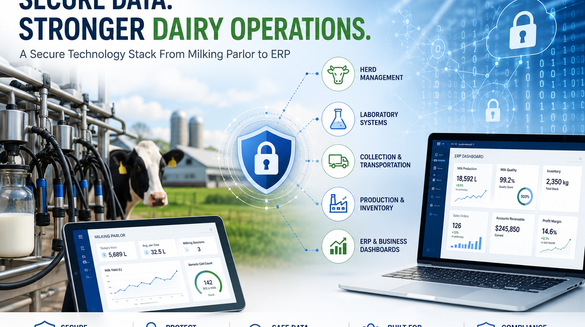
Securing the Connected Dairy Technology Stack From Milking Parlor to ERP
Modern dairy operations depend on a growing network of connected technologies. Milking parlors, herd management systems, laboratory software, mobile applications, and ERP platforms all work together to support daily operations. This connected environment improves efficiency, but it also increases the need to protect business data as it moves across different systems.
Today, securing a dairy business involves more than protecting financial records. Production data, herd information, milk quality results, inventory, supplier records, and customer data all need to remain accurate and accessible only to authorized users. A single weak point in the technology stack can affect multiple departments and disrupt day-to-day operations.
As more dairy businesses adopt dairy ERP software, they can centralize operational data while improving user access, reporting, and system integrations. In this article, we'll explore where security risks exist across the dairy technology stack and the practical steps organizations can take to protect their data from the milking parlor to the ERP system.
Why Dairy Technology Has Become More Connected Than Ever
Dairy operations no longer rely on a single system to manage daily activities. Production data is captured in the milking parlor, herd records are maintained in livestock management systems, milk quality is tracked through laboratory software, and inventory and financial information flow into ERP platforms. These systems work together to give teams a complete view of the business instead of isolated pieces of information.
This increased connectivity also means more data is shared across departments, locations, and devices. Farm managers, quality teams, warehouse staff, finance departments, and executives all depend on the same information to make decisions. When these systems are connected securely, businesses reduce duplicate data entry, improve reporting accuracy, and respond faster to operational issues.
However, every integration and connected device also expands the security footprint. Protecting data is no longer limited to the ERP system. Every application that stores or exchanges operational information must be secured to keep the entire dairy technology stack reliable.
Mapping the Modern Dairy Technology Stack
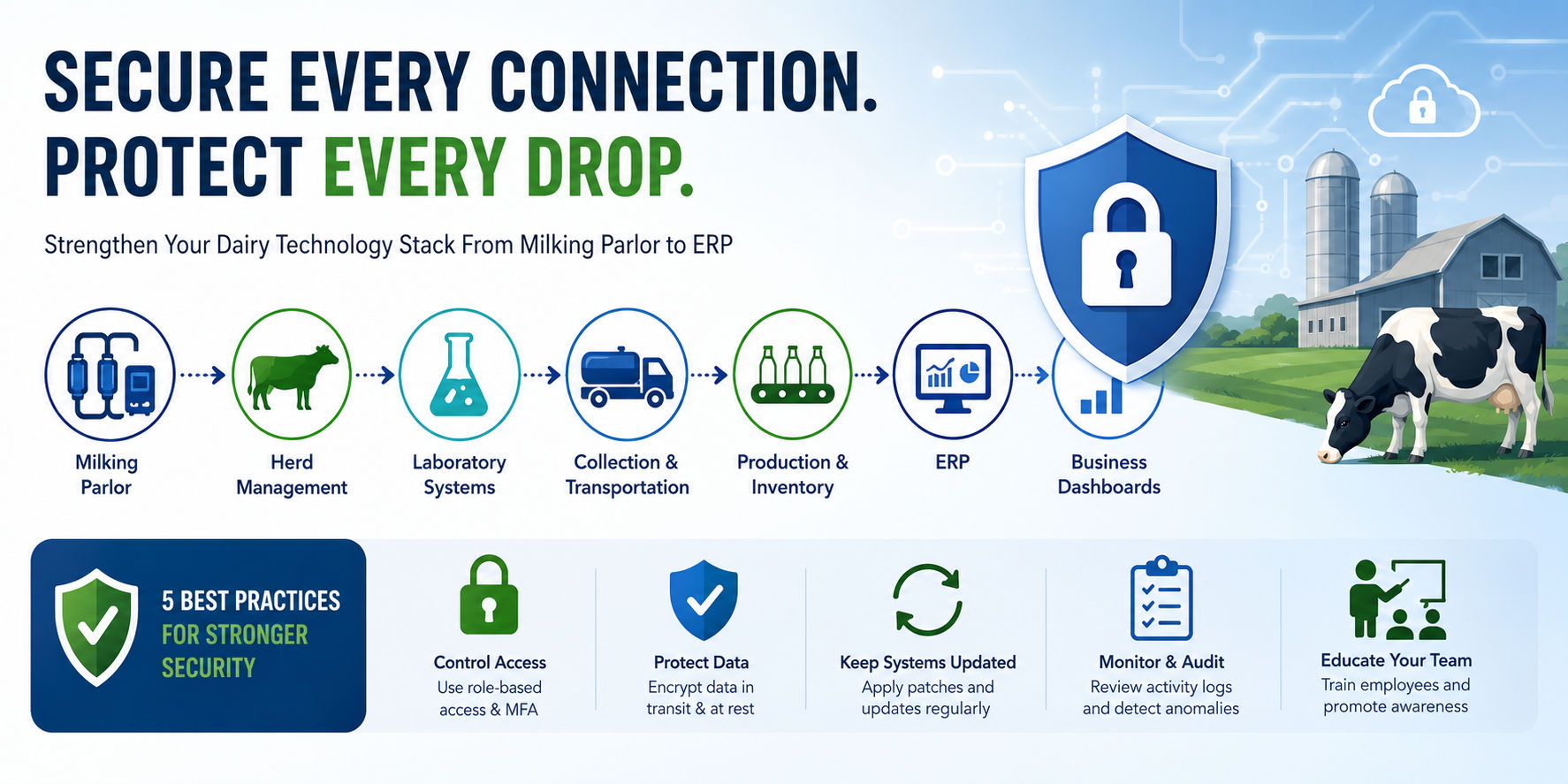
Every dairy operation relies on multiple systems that support different stages of production and business management. The process starts in the milking parlor, where production data is captured, then moves through herd management, laboratory testing, milk collection, production planning, inventory, and finally the ERP system. Each stage adds valuable information that supports daily operations.
Rather than working independently, these systems perform best when they exchange data automatically. For example, milk production records can update herd histories, laboratory results can support quality decisions, and inventory changes can flow directly into financial records. This reduces manual work and helps every department work with the same information.
Milking Parlor
│
▼
Herd Management
│
▼
Laboratory Systems
│
▼
Collection & Transportation
│
▼
Production & Inventory
│
▼
ERP
│
▼
Business Dashboards
Because data moves across several applications, security must be built into every connection. Protecting only the ERP system is not enough if information can be exposed while moving between the other systems in the technology stack.
Where Security Risks Exist Across the Dairy Technology Stack
Security risks can appear at every stage where data is collected, stored, or shared. Milking equipment, mobile devices, laboratory systems, and ERP platforms all handle valuable business information. If even one system has weak access controls or outdated security settings, it can become an entry point for unauthorized access or data loss.
Common risks include shared user accounts on milking equipment, lost mobile devices used by field staff, unsecured file transfers between laboratory and ERP systems, and employees having more system access than their roles require. Third party integrations can also introduce vulnerabilities if they are not monitored and updated regularly.
To reduce these risks, dairy businesses should secure every layer of the technology stack instead of focusing on a single application. This includes assigning role-based permissions, encrypting data during transfer, reviewing user activity, keeping software up to date, and regularly auditing integrations. A layered approach helps protect operational and financial data as it moves across the business.
Common security checkpoints
● Milking equipment and IoT devices
● Herd management systems
● Laboratory software
● Mobile phones and tablets
● APIs and third-party integrations
● ERP user permissions
● Cloud storage and business reports
Five Best Practices for Securing Dairy Business Data
Protecting dairy data starts with controlling who can access it. Employees should only have access to the information they need for their roles. Regularly reviewing user accounts, removing inactive users, and using strong authentication methods can significantly reduce the risk of unauthorized access. Mobile devices should also be secured with screen locks, remote wipe capabilities, and encrypted storage, especially for employees working across farms or processing facilities.
Businesses should also focus on protecting data as it moves between systems. Using secure integrations, encrypted connections, and keeping software updated helps prevent vulnerabilities from being exploited. Just as important is maintaining audit logs that record user activity and system changes. These records make it easier to investigate issues, identify unusual behavior, and support compliance requirements.
A strong security strategy does not rely on a single tool. It combines secure technology, clear user policies, and regular system maintenance to protect operational and financial data across the entire dairy technology stack.
Security Checklist
✔ Use role based user access
✔ Enable multi-factor authentication
✔ Secure company owned mobile devices
✔ Encrypt data during transfer and storage
✔ Review audit logs regularly
✔ Update software and security patches
✔ Remove inactive user accounts
✔ Monitor third party integrations
Why ERP Plays a Critical Role in Dairy Data Security
An ERP system sits at the center of the dairy technology stack, bringing together information from production, herd management, laboratories, inventory, purchasing, sales, and finance. Because so many business processes depend on it, the ERP also becomes the primary control point for securing operational data and managing user access.
Modern ERP platforms provide features such as role based permissions, audit trails, approval workflows, and centralized data management. Instead of maintaining separate security policies for every application, businesses can enforce consistent access rules and maintain a single source of truth across departments. This reduces the risk of duplicate records, unauthorized changes, and inconsistent reporting.
When implemented with secure integrations, an enterprise dairy ERP software solution can protect data without disrupting daily operations. Platforms such as Folio3 AgTech Dairy Software, built on Microsoft Dynamics 365 and NetSuite, securely connect milking systems, herd management applications, laboratory platforms, inventory, and financial operations into a unified environment. This gives dairy businesses greater visibility while maintaining stronger control over how information is shared across the organization.
Building a Secure Integration Strategy for Long Term Growth
Adding new technology should not create new security gaps. Before connecting another application, dairy businesses should evaluate how data will be exchanged, who will have access to it, and how that information will be protected. A well-planned integration strategy reduces manual work while maintaining control over sensitive operational and financial data.
Standardized APIs, encrypted data transfers, and centralized identity management make it easier to connect systems without compromising security. It is also important to test integrations before deployment, monitor them for unusual activity, and review permissions whenever new users, vendors, or software are introduced. These practices help ensure that every new connection strengthens the technology stack instead of creating additional risk.
As dairy operations continue to adopt automation and cloud-based platforms, secure integrations become a long-term business requirement rather than a one-time IT project. Organizations that build security into every integration are better positioned to scale their operations, maintain compliance, and keep critical business data protected as their technology ecosystem grows.
A Quick Security Checklist Before Expanding Your Dairy Technology Stack
Before investing in new software or connecting another system, review whether your current technology environment can support it securely. Addressing these fundamentals early helps reduce security risks and prevents integration issues as your operation grows.
| Checklist |
Why It Matters |
|
|---|---|---|
| Define user roles and access levels | Limits access to sensitive business data | |
| Use secure APIs for system integrations | Protects data exchanged between applications | |
| Enable multi factor authentication | Adds an extra layer of account security | |
| Keep all software updated | Reduces exposure to known vulnerabilities | |
| Review third party vendor security |
Ensures connected platforms meet security standards |
|
| Back up critical business data |
Supports faster recovery after unexpected incidents |
|
| Monitor user activity and audit logs |
Detects unauthorized access and unusual behavior |
|
| Train employees on cybersecurity basics |
Reduces the risk of human error and phishing attacks |
Treat security as an ongoing process rather than a one-time setup. Regular reviews, employee awareness, and continuous monitoring help ensure your dairy technology stack remains secure as your business adopts new systems and expands its operations.
Conclusion
The modern dairy industry depends on connected technologies to manage production, animal health, quality assurance, inventory, and financial operations. While these systems improve efficiency and visibility, they also increase the importance of protecting data across every integration, device, and application.
A secure dairy technology stack is built on strong access controls, encrypted data transfers, regular system updates, and a well-planned integration strategy. When security is considered at every layer, dairy businesses can reduce operational risk, improve compliance, and maintain confidence in the data that drives daily decisions.
As operations continue to modernize, security should grow alongside technology. Investing in connected systems is important, but ensuring those systems communicate securely is what allows dairy businesses to scale with confidence while protecting one of their most valuable assets: their data.

Safeguard Your Child Against Online Threat
Register Now Cancel Any Time
Available
on
Cancel Any Time
Available
on