
Published on Apr 16, 2026

Super Admin
Top telecom companies in the USA Worth Hiring in 2026
Choosing a telecom partner isn’t about brand names anymore. It’s about who actually understands how telecom works in the real world.
Systems don’t usually fail when they’re built. They start showing cracks when different pieces have to work together. What used to be one clean setup is now a mix of VoIP, AI, CPaaS, and OSS/BSS, all tightly connected.
And the problem is, when something’s off, it doesn’t crash. It just slows everything down, quietly.
That’s why choosing a telecom software development company isn’t just about picking a vendor anymore. It’s a decision that directly impacts your uptime, your ability to scale, and how flexible your system stays over time.
So before jumping into the list, let’s take a step back and understand what “top” actually means in 2026.
What Makes a Telecom Software Development Company the Right Choice in 2026
People don’t search for telecom partners out of curiosity. It usually starts with a problem that needs fixing or a system that needs to scale without breaking. The questions they ask reflect that. Not broad or theoretical, but practical, specific, and tied to real decisions.
Here are some of the most common questions that come up when evaluating telecom software development companies:
1. Strong Experience in OSS/BSS Software Development
OSS/BSS systems sit at the core of telecom operations. They manage things like billing, customer data, service activation, and network operations. Even a small change here can affect multiple parts of the system.
A company with real experience knows how these systems behave in day-to-day use. They understand dependencies, avoid risky changes, and make sure new features don’t break existing workflows.
2. Integration-First Approach (No Rip-and-Replace Mindset)
In most cases, your current system already has parts that work well. Replacing everything can be expensive, slow, and unnecessary.
The right telecom partner focuses on improving what’s already there. They connect new components with existing ones, make gradual changes, and avoid disrupting ongoing operations.
3. Expertise Across Modern Telecom Technologies
Modern telecom systems are made up of multiple technologies working together. Voice, messaging, real-time communication, and automation are often part of the same setup.
A strong development team understands how these different parts interact. They can design solutions that work smoothly across technologies instead of creating isolated components.
4. Proven Experience in High-Scale Environments
Many systems work well in testing but struggle when real users start using them at scale.
Companies that have handled high-traffic environments know how to design for performance. They consider things like load handling, system response time, and failure scenarios from the start.
5. Post-Deployment Support and Observability
Launching the system is just the beginning. Over time, issues can come up, performance can change, and new requirements can appear.
A reliable partner provides ongoing support, monitors system health, and responds quickly when something goes wrong. They also give you visibility into how your system is performing so you’re not operating in the dark.
Capability matters less than compatibility with your existing ecosystem. With that lens, here are the companies that actually stand out.
Who Are the Leading Telecom Software Development Companies to Look at in 2026?
The ones that can build, integrate, and scale telecom systems without disrupting what’s already running.
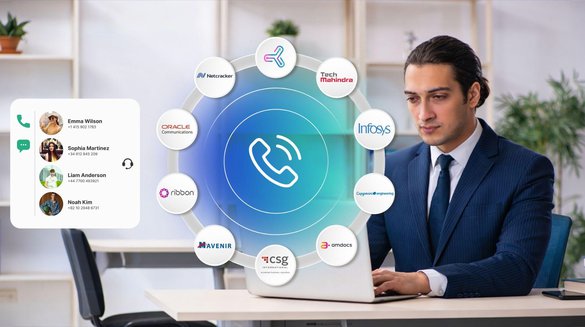
Some are US-based leaders, others are global companies working closely with US telecom businesses. What matters here isn’t where they’re headquartered, but how well they handle real-world telecom complexity.
1. TeleCMI
TeleCMI is a cloud communication platform focused on helping businesses manage customer interactions without building telecom infrastructure from scratch. It stands out for its plug-and-play approach, allowing teams to get started quickly with calling, tracking, and automation features, especially in sales and support environments. They are a strong fit for growing businesses that need communication systems up and running without heavy engineering effort.
Core capabilities: Cloud telephony, call tracking, IVR systems, call analytics, CRM integrations, and sales automation tools
2. Ecosmob
Ecosmob is a telecom-focused software development company known for building custom communication solutions for businesses across the US and globally. What sets them apart is their ability to work with existing telecom systems instead of replacing them, making integration smoother and faster. They are a strong fit for startups, service providers, and enterprises that want to build or scale telecom platforms without disrupting what’s already running.
Core capabilities: VoIP solutions, SIP-based systems, CPaaS platforms, AI-powered voice bots, and telecom application development.
3. Tech Mahindra
Tech Mahindra is a large telecom and IT services company with a strong footprint in the US telecom space. Their strength lies in handling complex, large-scale projects and working closely with major telecom operators. They are best suited for enterprises and telecom providers looking for end-to-end transformation and managed services.
Core capabilities: Network services, OSS/BSS solutions, 5G, and digital transformation for telecom operators.
4. Infosys
Infosys works with several telecom providers in the US, focusing on modernizing telecom systems and improving operational efficiency. They bring strong execution processes and experience with enterprise-scale systems. They are a good fit for large telecom businesses aiming to upgrade legacy systems and move toward more flexible, cloud-based environments.
Core capabilities: OSS/BSS modernization, cloud transformation, and telecom software development.
5. Capgemini Engineering
Capgemini Engineering, known earlier as Altran, focuses on telecom engineering and system integration projects. Their strength lies in handling technically complex environments and large integration projects. They are well suited for telecom operators and enterprises working on network upgrades and infrastructure-heavy transformations.
Core capabilities: Network engineering, 5G solutions, OSS/BSS, and system integration.
6. Amdocs
Amdocs is one of the most established telecom software companies with deep involvement in the US telecom ecosystem. Their strength is their long-standing relationships with major telecom operators and their ability to manage large-scale deployments. They are best suited for large telecom operators dealing with high volumes of customers and complex service structures.
Core capabilities: OSS/BSS systems, billing platforms, customer experience solutions, and cloud services.
7. CSG International
CSG International is a US-based company focused on business support systems, especially billing and customer management. They are known for reliability and strong billing systems that handle complex telecom operations. They are a good fit for telecom providers looking to improve billing accuracy and customer experience.
Core capabilities: Billing systems, revenue management, customer engagement platforms, and OSS/BSS solutions.
8. Mavenir
Mavenir is a US-based telecom software company focused on cloud-native network solutions. They stand out for their modern, cloud-first approach and open network architecture. They are ideal for telecom operators moving toward cloud-based systems and looking to modernize their network infrastructure.
Core capabilities: VoIP, IMS, messaging, cloud-native network solutions, and 5G infrastructure.
9. Ribbon Communications
Ribbon Communications focuses on real-time communication and voice infrastructure. Their strength lies in delivering secure and reliable voice communication systems. They are best suited for telecom providers and enterprises that rely heavily on voice communication and need strong security and performance.
Core capabilities: VoIP, SIP, session border controllers (SBC), and network security.
10. Oracle Communications
Oracle Communications offers telecom solutions as part of its larger enterprise ecosystem. Their strength is enterprise-level scalability and the ability to integrate with other Oracle systems. They are best suited for large enterprises and telecom operators already using Oracle or looking for a unified enterprise platform.
Core capabilities: Billing systems, cloud infrastructure, policy management, and OSS/BSS.
The “top” company depends less on ranking and more on your telecom maturity stage. That’s where most teams still struggle, choosing based on brand instead of fit.
How to Choose the Right Telecom Software Development Company for Your Needs
Choosing the right telecom software development company comes down to one thing: matching their strengths to what you’re trying to build or fix.
1. If you're building from scratch → look for architecture-first teams
When you’re starting fresh, the foundation matters more than features. You need a team that thinks about system design, scalability, and future integrations from day one, not just quick delivery.
Architecture-first teams focus on building something that won’t need to be reworked once usage grows.
2. If you're scaling → prioritize integration and performance optimization
Scaling isn’t about adding more features, it’s about making sure everything continues to work smoothly as usage increases.
Look for companies that understand system performance, can optimize existing flows, and know how to integrate new components without slowing things down.
3. If you're modernizing OSS/BSS → choose vendors with legacy + cloud experience
Modernizing OSS/BSS isn’t a simple upgrade. You’re dealing with systems that are deeply tied to your operations.
The right partner understands both legacy setups and modern cloud environments. They know how to move things forward step by step without breaking what’s already working.
4. If you're adding AI → ensure telecom-native AI deployment experience
Adding AI to telecom systems isn’t just about plugging in a model. It needs to work within real-time communication flows, without delays or disruptions.
Choose a company that has already deployed AI in telecom environments and understands how it fits into live systems.
The best choice aligns with your current bottleneck, not your future wishlist.
Let’s wrap this up with what really matters.
The Bottom Line?
Choosing between telecom software development companies isn’t about comparing features on paper. It’s about knowing what your system needs today and what it will need six months from now.
The right choice becomes clear when you focus less on who’s “top” and more on who fits your architecture, your scale, and your way of operating. That clarity is what prevents rework, delays, and performance issues later.
Because in telecom, short-term decisions show up as long-term problems if scalability and support aren’t built in from the start.

Safeguard Your Child Against Online Threat
Register Now Cancel Any Time
Available
on
Cancel Any Time
Available
on