
Published on Nov 24, 2026

Super Admin
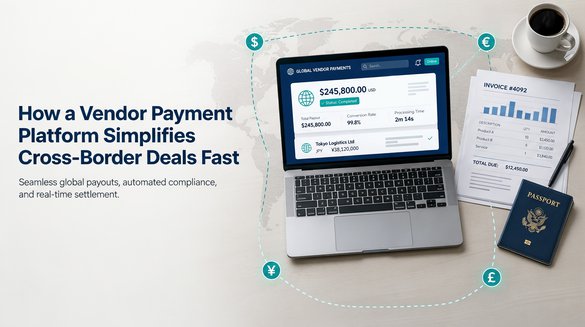
How a Vendor Payment Platform Simplifies Cross-Border Deals Fast
Cross-border purchasing creates foreign exchange exposure, payment delays, and reconciliation work for growing businesses. A vendor payment platform brings these tasks into one workflow by connecting supplier details, payment instructions, currency balances, and purchase records. It also gives finance teams clearer control over conversion costs and settlement timing. The result is faster execution with fewer manual checks. The sections below explain how this process works in daily operations and where businesses should focus first.
Why Centralized Workflows Are Important
Before a payment leaves an account, finance teams need to confirm the supplier, invoice, currency, amount, and delivery terms. A centralized workflow keeps these details together. This reduces repeated data entry and helps teams trace each transfer back to its source. For companies paying overseas factories or service vendors, dedicated payment platforms create a clearer record of every cross-border payment obligation.
Why Bank Wires Slow the Process
Traditional bank wires create separate currency conversion records. A finance employee often copies beneficiary data, checks exchange rates, submits the transfer, and later matches the bank statement against an invoice. Each handoff creates room for incorrect amounts, missing references, or delayed approvals.
The quoted exchange rate includes an FX margin, which is the difference between the mid-market rate and the bank’s rate. So, on a $50,000 wire, that margin typically costs more than the wire fee, and intermediary banks can deduct fees during transit.
Settlement can take two to five business days, which delays supplier confirmation and goods receipt. Month-end reconciliation then requires line-by-line matching across statements, invoices, and purchase orders.
One Workflow for Payment Control
An international vendor payments platform puts supplier payments, multi-currency balances, and source documents in one place. This way, businesses can make payments in multiple currencies across countries.
Holding currency balances lets a business choose when to convert funds instead of converting for every transaction. That approach helps companies match foreign currency receipts with supplier obligations in the same currency. It also gives finance teams a clearer view of upcoming cash requirements.
Payment methods can match the need for speed or cost. Finance teams can select the method that fits each corridor and payment deadline.
- Access Controls and Payment Records Improve Oversight
Access controls also help separate preparation, approval, and release. A team member can enter payment details, while an authorized reviewer confirms the amount and beneficiary before funds move. This division of work reduces avoidable errors without requiring separate systems.
Payment records should preserve the reason for each transfer. Connecting a payment to its supplier, quote, invoice, or purchase order gives finance teams evidence during internal reviews and routine account checks.
Automatic Reconciliation Reduces Close Work
Reconciliation speeds up when payments can be linked to their originating quote, invoice, or purchase order. Automatic matching removes repeated spreadsheet checks and gives the accounting record a direct source.
That link also helps teams investigate exceptions. If an amount, supplier, or currency does not match, the issue appears before the month ends rather than after several transfers have accumulated.
Procurement teams get a cleaner handoff from approved orders to paid suppliers. Finance teams get reliable records that show the following:
- What was purchased
- Who received funds
- Which currency settled the transaction
Faster Execution Across Supplier Corridors
A centralized payment process supports sourcing across different corridors without rebuilding the workflow for each supplier. A business can pay a factory in China, a component supplier in Vietnam, or a service vendor in Brazil through the same payment environment.
Typically, these settlements are faster than traditional international wire transfers on most corridors.
Businesses applying for access to vendor payment platforms provide the following details:
- Payment corridors
- Expected monthly volume
- Their current provider information
After review and compliance checks, most customers send a first payment within two to five business days, depending on the review.
What Finance Teams Should Check
Before adoption, finance leaders should map monthly volume, payment corridors, currencies, approval rules, and reconciliation needs. They should compare the full bank cost, including FX margin, wire charges, intermediary deductions, and staff time. A platform should fit existing quotes, invoices, and purchase orders without adding duplicate entries.
Cost review should also separate payment pricing from procurement software plans. Access requirements matter as much as price. A business should confirm compliance steps, settlement timing for its corridors, available currency methods, and who handles exceptions when a supplier payment needs attention.
Conclusion
Cross-border payment speed improves when purchasing data, currency decisions, and settlement records share one workflow. The practical test is simple: compare the current cost of a representative wire, trace the approval path, and measure the time needed to reconcile it. Then review corridor coverage, currency methods, and compliance steps before applying. Businesses that complete this check can choose a payment process based on recorded costs and operational fit instead of assumptions.

Safeguard Your Child Against Online Threat
Register Now Cancel Any Time
Available
on