
Published on Aug 14, 2026

Super Admin
What Are the Fundamental Steps to Build an AI-Powered SaaS Application?
Not too long ago, building a SaaS product meant writing solid CRUD logic, connecting a payment gateway, and calling it a day. Today, that baseline barely earns a second look. Buyers expect intelligence baked in: recommendations that feel eerily accurate, automation that removes the boring stuff, insights that surface before you even think to ask.
But "add AI to your SaaS" is easier said than shipped. There's real engineering complexity behind it, and the smartest teams don't try to figure it all out alone. Partnering with an experienced saas development agency that understands both product and AI architecture can be the difference between shipping something that works and burning months rebuilding it from scratch.
This guide walks through the fundamental steps, honestly and practically, so you can plan smarter before a single line of code is written.
Step 1: Start With a Problem, Not a Feature
The biggest trap in AI SaaS is building AI for the sake of it. A recommendation engine nobody asked for, a chatbot that adds friction instead of removing it. These are expensive distractions.
Before anything else, answer this: what painful, repetitive, or complex decision are your users making that data could improve?
That answer becomes your north star. Every model, every pipeline, every infrastructure choice should trace back to it.
Step 2: Understand Your SaaS Development Lifecycle
Building AI-powered software isn't a single sprint. The saas development lifecycle has distinct phases: discovery, architecture design, MVP development, AI model integration, testing, deployment, and iteration. Each phase compounds on the last.
Rushing through discovery creates technical debt that AI makes exponentially worse. A poorly scoped data model, for instance, can make training reliable ML models nearly impossible later. Treat each phase seriously.
Step 3: Choose the Right Cloud Infrastructure
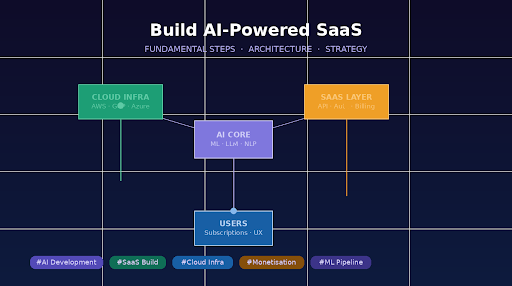
Your infrastructure isn't a footnote; it's load-bearing. The best cloud infrastructure providers for scaling AI SaaS solutions right now are AWS, Google Cloud Platform, and Microsoft Azure.
AWS has the broadest set of managed AI/ML services through SageMaker, making it a strong default for teams that want flexibility. GCP stands out if you're building on top of foundation models, with their TPU infrastructure and Vertex AI tooling being genuinely excellent. Azure wins when your buyers live in enterprise Microsoft environments, since integrations with Teams, Azure AD, and Microsoft 365 reduce sales friction considerably.
For early-stage products, many teams start on one cloud and multi-cloud later as scale demands it. Pick based on your AI workload and your customers' existing stack, not on which dashboard looks nicest.
Step 4: Define Your Tech Stack
Professional saas development company teams don't use one-size-fits-all stacks. That said, there's a reliable pattern that covers most AI SaaS builds:
Backend: Python (FastAPI or Django) handles AI/ML workloads naturally. Node.js works well for event-driven logic and real-time features. Both are commonly used in tandem.
AI/ML layer: TensorFlow and PyTorch dominate model training. For teams consuming pre-trained models, OpenAI's API, Hugging Face, or Cohere offer faster time-to-value. MLflow or Weights & Biases handles experiment tracking.
Frontend: React or Next.js for web; Flutter if you need cross-platform mobile.
Data: PostgreSQL for relational data, Pinecone or Weaviate for vector search, Redis for caching, and Kafka or RabbitMQ for event streaming.
DevOps: Docker, Kubernetes, Terraform, and CI/CD through GitHub Actions or GitLab CI.
This is what saas development firms working on production-grade systems actually deploy. The specific combination depends on your use case, but the categories don't change much. Teams looking to optimize Kubernetes costs at this stage usually pair those orchestration tools with a rightsizing review of node pools, since the compute footprint of training jobs and inference services can diverge sharply over a single quarter.
Step 5: Integrate AI Into What You Already Have
Not every AI project starts from scratch. Many companies need to know how to integrate AI capabilities into existing SaaS products without rewriting everything or confusing users who've built habits around your current interface.
The cleanest approach is API-first integration. Wrap your AI functionality behind an internal service layer, which isolates the AI logic from your core product so you can swap models or providers without touching your frontend.
Start with a shadow mode: run the AI in the background, log its outputs, compare them to current outcomes. Only surface the AI to users once you trust it. This builds internal confidence and catches edge cases before they hit production.
Feature flagging is your friend here. Roll out AI features to a cohort, measure impact, expand gradually. It reduces risk and creates clean before/after data.
Step 6: Monetise Your AI Features Thoughtfully
Here's where a lot of founders leave money on the table. The strategies for monetising AI features within a subscription software model fall into three broad buckets:
Tiered access: Gate the AI features behind higher plans. This works well when the AI saves significant time or replaces a role (e.g., an AI-generated first draft, an automated analysis report).
Usage-based pricing: Charge per API call, per document processed, per seat using AI tools. This aligns cost with value, which enterprise buyers in particular appreciate.
Outcome-based pricing: The frontier of SaaS monetisation. If your AI measurably reduces churn, increases revenue, or cuts processing time, you can price against a percentage of the value delivered. This is harder to sell but commands the highest multiples.
Don't bury AI features in a feature matrix. Market them as core product pillars. Customers are willing to pay a premium for intelligence, but only if they understand what it does for them.
Step 7: Plan for SaaS Development Cost Realistically
The saas development cost for an AI-powered product is genuinely wide-ranging, anywhere from $50,000 for an MVP with pre-trained model integrations to $500,000+ for a full custom model pipeline with enterprise security and compliance. However, AI SaaS building platforms like Rocket have brought the AI SaaS development cost down for early-stage teams by helping them build MVP interfaces, dashboards, workflows, and product prototypes before committing to full custom development.
Key cost drivers include data preparation (often underestimated), model training compute, inference costs at scale, and ongoing monitoring. Cloud inference bills can surprise you if you haven't modelled out usage patterns. Budget for these before you launch, not after.
Step 8: Choose the Right Development Partner
Unless you have strong in-house AI and SaaS engineering talent, you'll need outside help at some point. Knowing how to choose a saas development company matters more than most founders realise.
Look for a saas development agency with verifiable AI/ML work in their portfolio, not just web apps, but actual ML pipelines, model integrations, or data-heavy products. Ask about their experience with your industry's compliance requirements (HIPAA, SOC 2, GDPR). Check whether they understand product thinking, not just execution.
When engaging AI development services ask specifically about their MLOps practices. A team that ships a model but has no monitoring or retraining process is leaving you with a liability, not an asset.
Step 9: Work With Companies That Know Enterprise AI
For organisations building mission-critical platforms, the stakes of getting AI wrong are too high for general-purpose vendors.
Companies specialising in enterprise-grade SaaS solutions bring deep domain knowledge, enterprise security practices, and the architecture experience to scale without breaking. One company worth mentioning here is Bytes Technolab, a team with strong hands-on experience delivering enterprise SaaS and AI solutions across industries. Their work spans custom AI integrations, scalable cloud deployments, and full-cycle product development, making them a credible partner for companies serious about building AI SaaS that holds up under real-world pressure.
Step 10: Monitor, Retrain, Iterate
AI models are not deploy-and-forget software. Data distributions shift. User behaviour changes. What worked well at launch can drift into poor performance six months later without anyone noticing.
Build observability into your AI layer from day one. Track model accuracy, confidence scores, user acceptance rates (did they accept the AI's suggestion or override it?), and latency. Set up automated alerts when key metrics degrade. Schedule periodic retraining as part of your product roadmap.
The teams that win long-term in AI SaaS aren't the ones who built the best model on day one. They're the ones who built the best feedback loop.
Closing Thoughts
Building an AI-powered SaaS product is genuinely exciting, and the opportunity is real. But it rewards teams who plan carefully, start focused, and resist the temptation to sprinkle AI everywhere at once.
Define the problem. Architect for scale. Integrate thoughtfully. Price for the value you deliver. And build with partners, whether internal or external, who take the engineering seriously.
That's not a guarantee of success, but it's a much better foundation than most teams start with.

Safeguard Your Child Against Online Threat
Register Now Cancel Any Time
Available
on
Cancel Any Time
Available
on