
Published on Nov 26, 2026

Super Admin
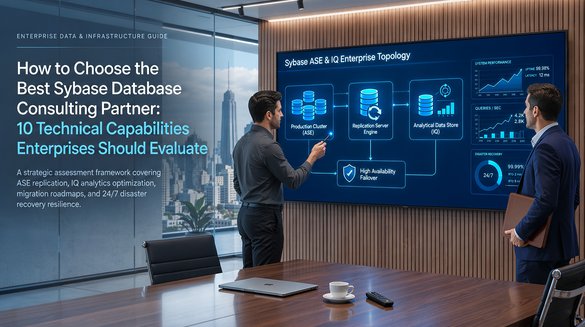
How to Choose the Best Sybase Database Consulting Partner?
Most enterprises do not replace their database consulting partner often, and that is exactly why the selection matters. The chosen firm will touch production systems, sensitive data, and the platforms that keep revenue flowing. Sales presentations tend to look alike, with similar promises of expertise and responsiveness. The real differences appear only when an upgrade goes wrong at midnight, or a performance problem resists the usual fixes. Selecting the best Sybase Database Consulting partner is therefore a technical decision as much as a commercial one, and it deserves a structured evaluation.
What Separates a Strong Partner From an Average One
SAP ASE is a mature platform with a shrinking pool of specialists. Many providers list Sybase among dozens of supported databases, yet have only a handful of engineers with real production experience on it. The gap between general database administration and genuine ASE depth becomes obvious during complex work such as optimizer tuning, replication recovery, or cross-platform migration.
The firms that stand out as the best Sybase Database Consulting providers combine engine-level knowledge with disciplined processes, proven tools, and clear accountability. The ten capabilities below offer a practical framework for testing those qualities during selection, rather than relying on claims alone.
10 Technical Capabilities to Evaluate
1. Deep Knowledge Across SAP ASE Versions
Enterprise estates often run several ASE releases at once, from older 15.x servers to current 16.x installations. A capable partner understands how the optimizer, kernel, and configuration defaults changed between versions. Ask candidates to explain the practical differences between releases your organization runs. Vague answers usually signal limited hands-on experience. Strong candidates also know which features require separate licensing, which helps avoid costly surprises during audits.
2. Performance Tuning and Query Optimization
Strong consultants diagnose performance using evidence: monitoring tables, wait events, query plans, and baseline comparisons from tools. They should be able to describe a structured method for finding root causes rather than a list of generic tips. Request an example of a difficult performance case they resolved and how the result was measured.
3. Replication Server and High Availability Skills
Replication is one of the most specialized areas of the Sybase ecosystem. Look for experience with warm standby, multi-site replication, and the Always-on HADR option, including recovery from broken replication queues. Partners who have rebuilt replication under pressure bring knowledge that documentation alone cannot provide. It is worth asking how they would resynchronize a standby database after a long outage without stopping the primary system.
4. Backup, Recovery, and Disaster Recovery Testing
Every provider claims to handle backups. Fewer can show tested restore times, documented point-in-time recovery procedures, and records of regular disaster recovery drills. Ask how often they test restores for clients and what they do when a test fails to meet the agreed recovery time objective.
5. Upgrade and Platform Migration Experience
Version upgrades, hardware refreshes, and moves to Linux or cloud infrastructure each carry distinct risks. Many enterprises are also evaluating migration from ASE to SQL Server. A strong partner has completed these projects repeatedly and can describe their testing approach, rollback planning, and how they handled compatibility issues in previous engagements.
6. Security Hardening and Compliance Support
Regulated industries need partners who understand auditing, encryption, granular permissions, and separation of duties within ASE. The right firm can map database controls to compliance requirements and help prepare evidence for auditors, rather than leaving the client to translate technical settings into compliance language.
7. Proactive Monitoring and Alerting
Reactive support waits for users to complain. Proactive support detects rising lock waits, filling transaction logs, replication lag, and capacity trends before they affect operations. Ask what is monitored, how alert thresholds are set, and how quickly alerts reach an engineer. Sample monthly health reports are also useful, since they show whether findings lead to real recommendations or simply fill pages.
8. Round-the-Clock Support With Defined Service Levels
Mission-critical systems need coverage at all hours. Evaluate response time commitments for each severity level, the escalation path, and whether senior ASE engineers are available at night or only junior staff. Service level agreements should include measurable targets and regular reporting.
9. Automation of Routine Operations
Manual maintenance invites inconsistency. Mature partners automate health checks, statistics updates, consistency checks, backups, and reporting through tested scripts. Automation frees experienced engineers to focus on complex problems while keeping routine work reliable and auditable. Every automated job should also report its own success or failure, so a silent problem never goes unnoticed for weeks.
10. Documentation and Knowledge Transfer
A good partner leaves the environment better documented than it found it. Runbooks, architecture diagrams, and change records should belong to the client and remain usable if the relationship ends. Regular knowledge transfer sessions also strengthen the internal team instead of creating dependence.
A Simple Scorecard for Comparing Providers
A structured scorecard helps evaluation teams compare candidates consistently and avoid decisions based mainly on price or presentation quality.
| Evaluation Area | Questions to Ask | Signs of a Strong Answer |
|---|---|---|
| ASE expertise | Which ASE versions and features have your engineers supported in production? | Specific releases, named features, and real project examples |
| Performance and HA | How do you diagnose slowdowns and recover broken replication? | A clear, evidence-based method with measurable outcomes |
| Recovery readiness | When did you last run a restore test for a client? | Recent dates, measured restore times, and documented results |
| Support model | Who answers a critical call at 2 a.m.? | Named senior engineers and defined escalation steps |
| Transparency | What documentation will we own at the end of the contract? | Complete runbooks, diagrams, and change history handed over |
Scoring each area on a simple scale, then weighting the areas that matter most to the business, turns a subjective decision into a defensible one.
Questions Buyers Often Ask
Should the partner be ASE-specialized or a general database provider?
For critical Sybase systems, specialized depth usually matters more than breadth. General providers can work well if they demonstrate dedicated ASE engineers with recent production experience.
Is a trial engagement a good idea?
Yes. A short health check or performance assessment reveals working style, technical depth, and communication quality before a long-term commitment.
How important is migration experience if no migration is planned?
Quite important. Platform plans change, and a partner who understands both ASE and target platforms such as SQL Server can advise objectively when the time comes.
Making the Final Choice
Choosing a database partner is ultimately about trust backed by evidence. Testing candidates against these ten capabilities, asking for concrete examples, and scoring answers consistently reveals which firms can truly protect and improve critical systems. The best Sybase Database Consulting partner combines deep ASE knowledge with dependable processes and a willingness to share what it knows. Enterprises comparing providers can review how the team at ralantech.com approaches Sybase support, performance, and migration work, and starting with a focused health check is a practical way to evaluate expertise before making a long-term commitment.

Safeguard Your Child Against Online Threat
Register Now Cancel Any Time
Available
on