


Published on Aug 13, 2026

Super Admin
The Field Guide to Getting Found Before the First Estimate Call
Homeowners rarely call the first landscaping company they think of — they search, compare a handful of options, and often decide who to contact before ever picking up the phone. This means the real competition for new landscaping business increasingly happens on a search results page, well before any estimate call takes place.
Understanding the effects of landscaper seo on visibility gives one an insight into why some companies keep coming up ahead of their rivals. Understanding the particular signals that result in certain businesses appearing first makes competing for such recognition more feasible as opposed to simply going by reputation alone.
Marker 1: Local Service Page Depth
Businesses that rank consistently well tend to build out distinct pages for each core service — lawn maintenance, hardscaping, irrigation, seasonal cleanup — rather than describing everything on a single general page.
What strong service pages typically include:
● Specific descriptions of the work involved, not generic marketing language
● Local landmarks or neighbourhood references where relevant
● Before-and-after project examples
● Clear calls to action tied to that specific service
A business relying on one broad page to cover all services tends to compete less effectively than one with dedicated pages, since each specific page can target distinct search terms a general page can't address as precisely.
Marker 2: Review Volume and Recency
Review signals carry substantial weight in local search rankings, and recency matters nearly as much as total volume.
| Review Pattern | Typical Impact |
|
Steady stream of recent reviews |
Signals active, trustworthy business |
|
Large volume but no recent activity |
Weaker signal than steady, recent reviews |
|
Few or no reviews |
Meaningfully disadvantaged in local rankings |
An effective SEO strategy consistently includes an active review generation process — asking satisfied customers to leave feedback shortly after project completion — rather than treating reviews as an occasional afterthought.
Marker 3: Seasonal Content Timing
There are seasons to the landscaping business, and firms that post content prior to each season have an advantage over other competing firms that may post their content when demands have hit their peaks.
Seasonal content opportunities:
● Spring cleanup and planting guides published in late winter
● Irrigation system prep published before early summer heat
● Fall leaf removal and winterisation content published in late summer
Marker 4: Visual Proof of Work
Landscaping is one of the visual service categories, and firms that post pictures of their projects generate more trust indicators than firms that use text descriptions only.
Effective visual content practices:
● High-quality before-and-after photo sets for completed projects
● Photos organized by service type and neighborhood
● Video walkthroughs of larger hardscaping or landscape design projects
Marker 5: Citation Consistency Across Directories
Search engines cross-reference business information across multiple directories to confirm legitimacy, meaning inconsistent name, address, or phone number listings can quietly undermine an otherwise strong search presence.
Putting the Markers Together
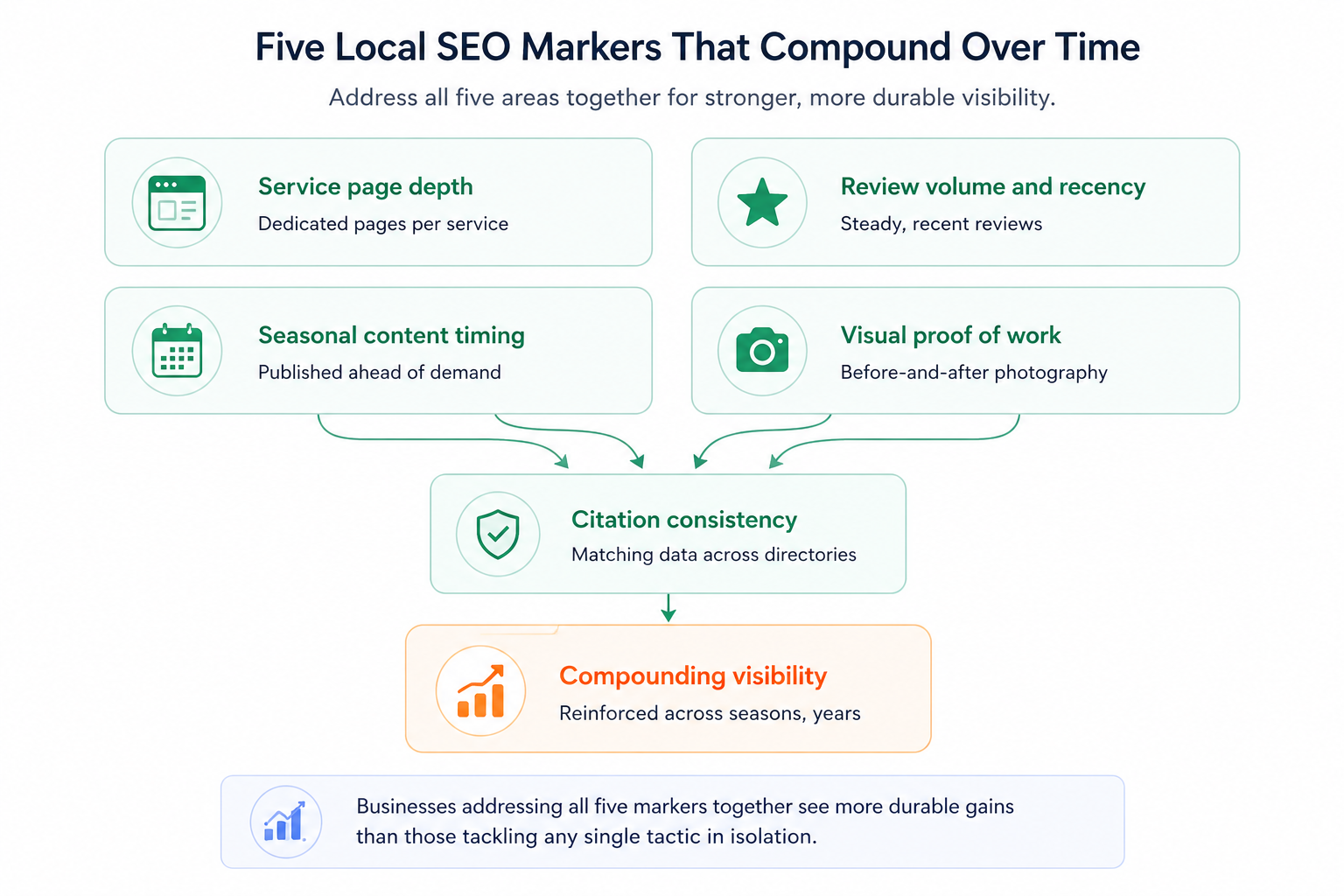
None of these factors operates alone, and organizations that concentrate on one or two usually fail to make significant progress when it comes to increasing their visibility in search. A firm could have outstanding seasonal content yet still underperform because of insufficient reviews, or vice versa, with reviews being good and citations not consistent.
This is precisely why an all-encompassing strategy for landscaper SEO often views all five indicators in connection with each other rather than tackling them separately. A company that spends resources on generating season-specific material but also establishes a presence in review sites, ensures proper citation data, and provides solid visual evidence of its accomplishments is likely to experience higher compounded success from its efforts. Since each marker reinforces the others — strong reviews support trust signals that make seasonal content more effective, and consistent citations support the overall credibility that search engines weigh across every other factor — treating the fundamentals as a connected system rather than a checklist tends to produce more durable results over time, particularly across multiple growing seasons rather than a single push before one seasonal peak.
What Separates Businesses That Stay Visible Long-Term
Reviewing landscaping businesses with strong, sustained visibility over several years reveals a consistent pattern: none of them treats search presence as a one-time project. They continue publishing seasonal content each year, keep review generation active as an ongoing practice, and periodically audit citation consistency as their business grows and changes. Businesses that instead treat visibility work as a single setup effort — building it once and moving on — typically see gradual decline as competitors continue investing in the same fundamentals season after season.
For a landscaping business evaluating where to start, prioritising these five markers together, rather than tackling them one at a time over an extended period, tends to produce visible movement in search rankings well before the next estimate call ever gets scheduled.

Safeguard Your Child Against Online Threat
Register Now Cancel Any Time
Available
on
Cancel Any Time
Available
on