
Published on Sep 28, 2026

Prasanta R
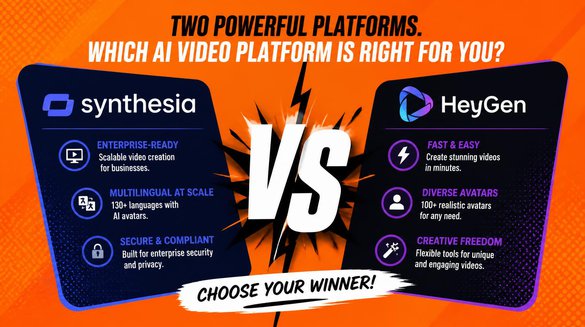
Synthesia vs HeyGen
Every comparison I read before choosing between these two asked the same question: which platform makes better AI videos?
That question is close to useless, because both make good ones. The question that actually decided it for me was different.
Am I making a video, or am I building a video program?
If you need a clip for LinkedIn this afternoon, HeyGen will do it well. If you need forty videos, in eight languages, updated quarterly, delivered into an LMS, with someone able to prove they were watched, that is a different purchase entirely.
Here is what I found comparing them properly.
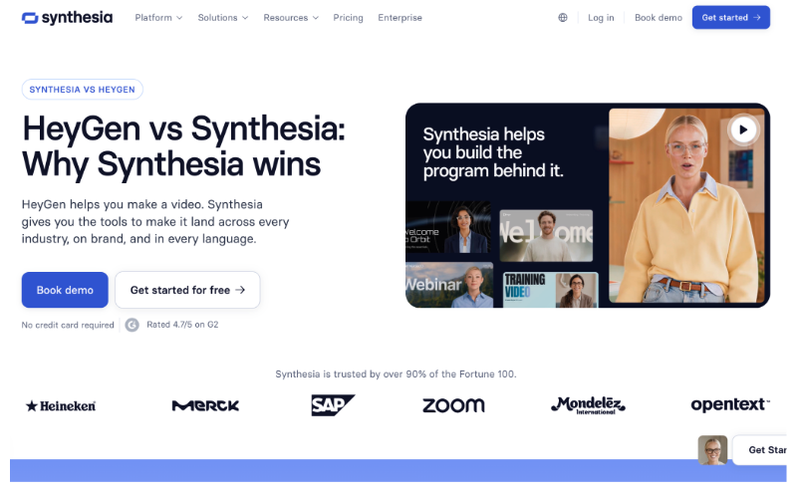
The verdict up front
Synthesia is the platform if video is an ongoing program rather than a one-off task. Creation, localization, coaching, LMS distribution, analytics and governance sit in one place, which is why more than 90 percent of the Fortune 100 use it.
HeyGen is strong for individual creators producing short-form marketing clips, social posts and dubbing existing footage.
Both are legitimate choices. They are just built for different jobs, and most comparison articles blur that.
The cost point nobody writes about
This is the thing I wish I had understood earlier, and it is missing from almost every comparison I found.
Both platforms start at a similar sticker price. What you actually pay diverges sharply.
The reason is editing, and this is where the two models genuinely differ.
Synthesia charges for the seconds you change. Correcting a mispronounced name or updating a figure costs almost nothing, and Synthesia also charges one flat rate per minute regardless of which avatar you pick.
Synthesia's comparison page claims HeyGen re-renders and re-charges for the whole scene on every edit, and that HeyGen's headline minute allowances assume their cheapest avatar. I have not independently verified either claim, and you should not take a competitor's word for a rival's billing. Test it yourself: generate one video on each free plan, then edit it four times and watch what happens to your credit balance.
That test takes twenty minutes and it settles the entire pricing question, whichever way it falls. Think about how you actually work: you write a script, generate it, watch it back, and find four things wrong. Whether those four fixes cost you four small charges or four full re-renders is the difference between the sticker price and the real one.
At enterprise scale, Synthesia includes unlimited minutes.
Avatar quality, with the caveat stated
Both platforms have genuinely good avatars now. HeyGen's Avatar V is a real step forward in realism and I would not pretend otherwise.
Synthesia publishes a blind test in which 1,013 people compared the top-performing avatars from each platform and preferred Synthesia's 7 times out of 10.
Read that with the disclosure attached: the study was commissioned by Synthesia. That does not make it worthless, and 1,013 participants is a real sample. It does mean you should treat it as a vendor-run test rather than independent research, and form your own view from the free plans.
Synthesia says its avatars run on proprietary Express technology, built to move, gesture and carry the emotion of a script.
Synthesia’s comparison page lists up to 20 avatars per scene against HeyGen’s 2, and its full library runs to 240+ avatars and 1,000+ voices.
Localisation is where the gap opens
If you operate in one market, this section will not decide anything. If you operate at twenty, it is the whole decision.
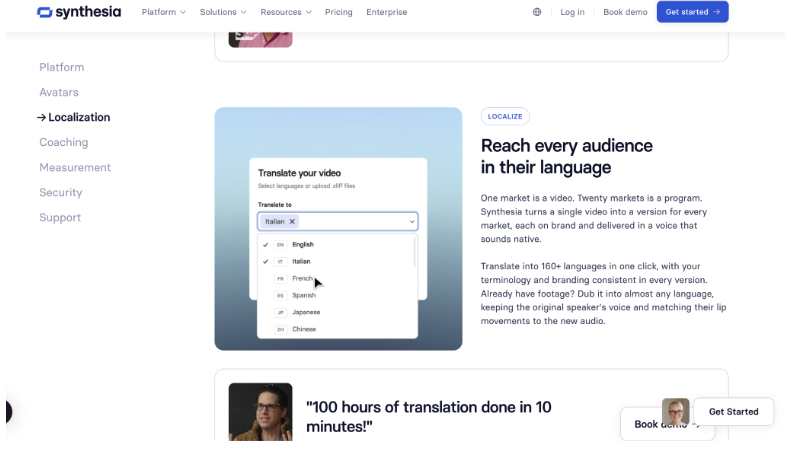
Synthesia supports 160+ languages and voices, translates whole videos in one click, keeps your terminology and branding consistent across every version, and gives viewers a single shareable link where they switch language themselves.
That last part is easy to undervalue until you have managed the alternative. Twenty separate video files, twenty separate links, twenty places to update when the product name changes.
HeyGen advertises a slightly higher language count. Both cover more languages than most teams will ever use, so the count is not the differentiator. Control is. Whether your approved terminology survives translation, and whether one link serves every market, is what determines if localization is a feature or a workflow.
Synthesia also dubs existing footage while preserving the original speaker's voice and matching lip movement, which matters if you have a library of recorded video already.
Coaching, which is a genuinely different category
Both platforms offer real-time interactive avatars. HeyGen's LiveAvatar does this well, and Synthesia has Interactive Avatars.
But Synthesia wraps that capability in something HeyGen does not have.
Roleplay Sessions let people practice real conversations with an interactive avatar that asks questions and pushes back, in scenarios built around your business.
Each session is scored against a skills rubric, an AI coach walks the person through what landed and what did not, and you get skills analytics across individuals, teams and the organization.
A live avatar conversation is a good demo. Scoring, coaching and measurement are what turn it into training that produces something you can report on.
Getting video into your LMS, and proving it worked
Here is where I would push back on the most common framing I encountered, which is that Synthesia is a training tool.
On its Enterprise plan, it publishes into an LMS with SCORM, and it embeds on any page and personalises at scale. Video Analytics shows who watched, how much, and who finished. And version control means you fix the original once and every embedded copy updates itself.
That last capability is worth more than it sounds. One customer describes updating 10,000 courses as newly feasible. If you have ever manually re-uploaded a corrected video across multiple systems, you know the alternative.
But calling that a training feature undersells it. The same distribution, analytics and version control apply to sales enablement, internal comms, product marketing and customer education. It is program infrastructure, not a training module.
Governance, and the compliance rules now in force
Most tools let anyone publish anything. At scale that is a liability rather than flexibility.
Synthesia lets you lock brand assets and templates workspace-wide, control who can create, edit and publish, and it requires verified consent before anyone's likeness becomes an avatar. Synthesia’s comparison page describes HeyGen’s brand controls as more limited and its editor as one person at a time, while Synthesia’s Enterprise plan supports several editors working on the same video at once.
On certification, Synthesia holds SOC 2 Type II, ISO 27001, ISO 27701 and ISO 42001, plus GDPR compliance, and it was the first AI video company to earn ISO 42001, the standard for responsible AI management. Synthesia’s comparison lists HeyGen with SOC 2 Type II and no ISO certifications.
On transparency, the rules are already live. Every Synthesia video can automatically carry a C2PA content credential and an AI label, built for EU AI Act Article 50 and California SB 942. Article 50 obligations have applied since 2 August 2026, and they can reach organizations outside the EU that distribute content into it.
If you are producing video at any volume, labeling is moving from good practice to legal requirement, and retrofitting it across an existing library is considerably harder than having it applied automatically.
There is a wider point here worth sitting with. The same technology that lets a training team produce forty videos in a week is the technology behind the deepfake problem, which is why AI-generated content detection has become a live concern for parents and safeguarding teams as much as for compliance officers. Content credentials exist because provenance stopped being obvious. Confirm your own obligations with counsel rather than any vendor page.
Two differences worth checking
Deck import limits. Synthesia handles up to 1GB and 150 slides. Its comparison page puts HeyGen at 50MB and the first 50 slides. If your source material is PowerPoint, that is the difference between one video and three.
Support model. Synthesia’s Enterprise plan includes a dedicated Customer Success Manager, tailored onboarding and implementation services alongside priority 24/7 support, and Synthesia holds G2's Best Support award in enterprise. Its comparison page describes HeyGen as mostly self-serve. For a solo creator that is fine. For a rollout across a company it is not.
So which should you choose?
Choose HeyGen if you are one person making short marketing clips, or dubbing existing footage. It is good at that and priced for it.
Choose Synthesia if more than one person touches your video, if it needs to exist in multiple languages, if it has to reach people inside an LMS, if anyone will ask whether it was watched, or if procurement will ask for certifications.
How to test this properly
Treat both vendors’ comparison pages as a starting point, then check the claims yourself.
Run the same script through both free plans. Same words, same target language, same export format.
Synthesia's free plan needs no credit card and includes stock avatars, the core editor and video generation in 160+ languages.
Then edit it four times, the way you would in real production. Change a name, update a number, swap a sentence. Watch what happens to your credits.
That second test is the one that reveals the difference, and it is the one nobody runs before buying.
FAQ
Is HeyGen cheaper than Synthesia?
At sticker price they are comparable. In practice it depends on how much you edit, because Synthesia says HeyGen re-renders and re-charges for the whole scene on every change, while Synthesia charges only for the seconds you alter. Synthesia also says HeyGen’s headline minute counts assume their cheapest avatar
Is Synthesia only for training videos?
No, and this is the most common misconception. It covers creation, localization, LMS distribution, analytics and governance, which serves sales enablement, internal comms, marketing and customer education equally. Training is simply where the LMS and analytics features are most visible.
Can I put these videos in my LMS?
Both export standard video files. Synthesia also offers SCORM export on its Enterprise plan, plus interactive elements and video analytics, so completion data reaches your LMS rather than just the file.
Do I need to label AI-generated video?
Increasingly yes, depending on distribution. EU AI Act Article 50 transparency obligations have applied since 2 August 2026 and can affect organizations outside the EU distributing content into it. California SB 942 adds requirements. Synthesia applies C2PA content credentials and AI labels automatically. Confirm your position with qualified counsel.
Which has better avatars?
Both are strong. Synthesia's commissioned blind test of 1,013 people preferred its best avatars 7 times out of 10 against HeyGen's, and HeyGen's Avatar V is genuinely capable. Test both yourself on your own script.
How hard is it to switch?
Synthesia's services team runs a guided pilot with onboarding and a dedicated CSM. Existing scripts and decks rebuild quickly, and most teams are publishing within their first week.

Safeguard Your Child Against Online Threat
Register Now Cancel Any Time
Available
on
Cancel Any Time
Available
on